When you click on links to various merchants on this site and make a purchase, this can result in this site earning a commission. Affiliate programs and affiliations include, but are not limited to, the eBay Partner Network.
Finally getting my 78 back together having completely gone through removing cleaning and replacement of all top end, rubber lines and hoses. I had removed the distributor, so needed to recheck the timing. Have confirmed TDC with cams and distributor housing and removed the vacuum line. When I put the timing light/gun on and run the engine at 3000 rpm (set at 30 degrees BTDC), the line is jumping around a bit, approx. + or - 5 to 10 degrees. Is this correct ? Seems it to me it should be pretty steady. If this is not correct - any ideas on what might be causing this issue.
I have all new plugs wires, distributor cap and rotor. Green wire does appear to be very new (still bright green in color) but was installed by PO so I don't really know its age.
Expanding on John's question, remember that the early cars have a combination of centrifugal advance and vacuum advance/retard that affect the timing. Depending on how smooth the car is idling, timing at idle can move as RPM's change. There's a reason why you normally check timing at an engine speed that causes full centrifugal advance. It's somewhere around 3K IIRC -- check the WSM for the actual spec.
The centrifugal advance uses a pair of swinging weights held close to center by small springs. The little pivot pins for the weights need to be lubricated to work correctly, as do the surfaces that the weights slide on. There's some minor disassembly needed to do a thorough clean and lubrication on the weights. The bearings for the distributor shaft get loose over time too, allowing the shaft to rock and the timing to jump around. Old-school machine shops have "distributor machines" that map advance as they spin the distributor. Might be worth some searching if there's a question about distributor condition. Start with the cleaning and lubrication of the weights and pins, and the moving plate that the vacuum can pulls and pushes.
Expanding on John's question, remember that the early cars have a combination of centrifugal advance and vacuum advance/retard that affect the timing. Depending on how smooth the car is idling, timing at idle can move as RPM's change. There's a reason why you normally check timing at an engine speed that causes full centrifugal advance. It's somewhere around 3K IIRC -- check the WSM for the actual spec.
The centrifugal advance uses a pair of swinging weights held close to center by small springs. The little pivot pins for the weights need to be lubricated to work correctly, as do the surfaces that the weights slide on. There's some minor disassembly needed to do a thorough clean and lubrication on the weights. The bearings for the distributor shaft get loose over time too, allowing the shaft to rock and the timing to jump around. Old-school machine shops have "distributor machines" that map advance as they spin the distributor. Might be worth some searching if there's a question about distributor condition. Start with the cleaning and lubrication of the weights and pins, and the moving plate that the vacuum can pulls and pushes.
The engine was at 3000rpm with the vacuum hose disconnected and plugged (not sure if it needed to be plugged or not) when trying to make the adjustment. Thanks for the suggestion on cleaning and lube I will take a look at that.
Also just to confirm one of my original questions - are you guys saying it should indeed be a rock solid timing mark at 3000 rpm ?
it should be steady ,
that said, and your seeing it jumping around,
its quite possible you have a misfire and or a plug wire crossed.
The other thing to look for is inside the distributor above the advance weights is a 8 finger trigger ring ,
Now looking carefully, this ring is held in alignment to the shaft via a small roll pin under the C clip ring.
Its possible for this pin to come out and the trigger ring will get loose and spin on the shaft.
worst case the timing will be so far off the engine wont run but it might fire once in a while.
With a mytivac you can test the vacuum advance unit with the cap off to see how it operates/.
NOTE the dizzy shaft will have a small amount of back and forth play by turning the shaft with the rotor
it should be steady ,
that said, and your seeing it jumping around,
its quite possible you have a misfire and or a plug wire crossed.
The other thing to look for is inside the distributor above the advance weights is a 8 finger trigger ring ,
Now looking carefully, this ring is held in alignment to the shaft via a small roll pin under the C clip ring.
Its possible for this pin to come out and the trigger ring will get loose and spin on the shaft.
worst case the timing will be so far off the engine wont run but it might fire once in a while.
With a mytivac you can test the vacuum advance unit with the cap off to see how it operates/.
NOTE the dizzy shaft will have a small amount of back and forth play by turning the shaft with the rotor
Funny you should mention a "misfire". This adventure started out chasing a misfire. Starts approx. 1500rpm thru 3000rpm then pulls strong. As mentioned, I have now gone through the whole top end, replacing and cleaning pretty much everything. Had the WUR and Fuel Distributor checked (all ok). Just now putting everything back together. New Plugs, Leads, Cap, Rotor and all rubber hoses. Could it be the ignition distributor causing this issue ?
it really could be a crossed spark plug wire ,
look at the engine firing order picture,
identify #1on the cap,
and the dizzy rotation ,
then count the wires
Look carefully at the centrifugal advance as I described above. You can grab the rotor and twist it slightly, forcing the weights out against the springs. The total rotational movement available is pretty small; consider that 6º on the distributor shaft advance equates to 24º on the crank for example. A little looseness or even some binding will affect timing a lot. Sticking especially will mess you up, as correct timing at 3000 RPM will be way too far advanced at idle if the weights don't adjust rotor position back correctly.
It's sometimes tempting to just drop the whole distributor in the solvent tank as part of some larger engine maintenance project. That leaves the pins and weights dry. A film of lithium grease or even a spray of Triflow into the area below the reluctor can be enough to free the centrifugal advance mechanisms.
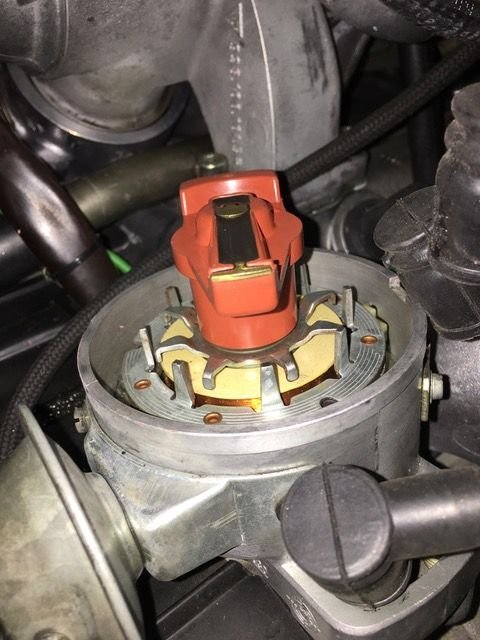
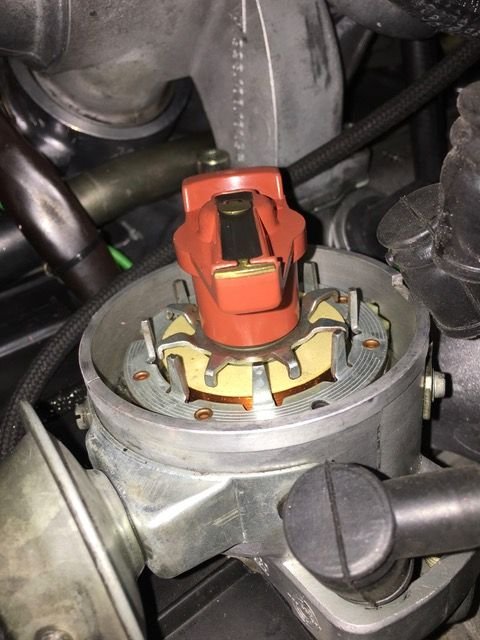
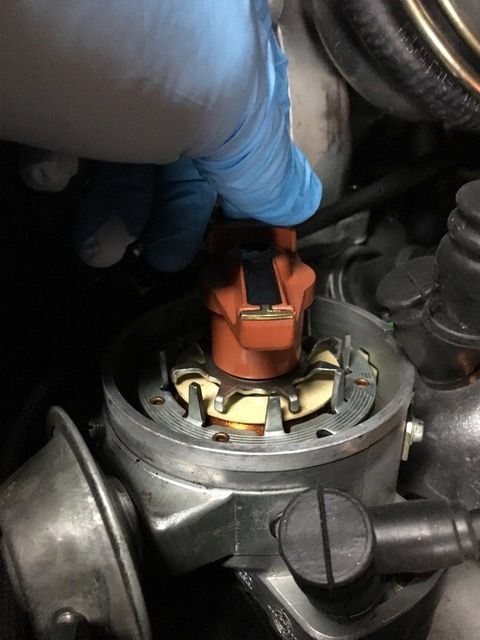
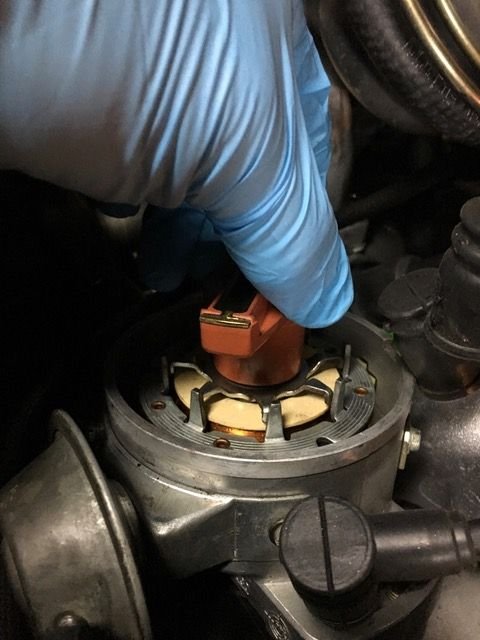
Double checked the plug wires last night and all are connected tightly and in order. Also checked the distributor advance and retard which also seems to be ok. Here are a couple of photos to show the movement. I attached a Mity Vac to the vacuum port and observed the movement. The first two pics show how far the rotor moved once the vac was applied. I then manually rotated the rotor (to check the mechanical advance), it seemed to move quite nicely back and forth under spring tension. The 2nd set of photos show how much movement there is. It all seems pretty good to me but do you guys think these phots illustrate enough movement. What next ? Really struggling to understand what else could be causing the missfire.
No Vacuum
Vacuum Applied
Static Position
Manually turned clockwise (Advance)
Rotor springs back to original position as soon as I let go.





 Timing marks jumping around