


Alignment Help Needed....

Thread Starter
Advanced
Joined: Jul 2009
Posts: 81
Likes: 0
From: Rogers, AR
 Alignment Help Needed....
I have GMG upper and toe arms on my car. Just ordered the Tarett locking plates.
I have taken the car to three shops in NW AR and two would not work on the car at all and the third really botched the job. I have no issues setting toe and camber myself but thrust angle is another story. Does anyone have a suggestion regarding a good shop in Kansas, Dallas Tulsa or anywhere in AR?
Thanks
I have taken the car to three shops in NW AR and two would not work on the car at all and the third really botched the job. I have no issues setting toe and camber myself but thrust angle is another story. Does anyone have a suggestion regarding a good shop in Kansas, Dallas Tulsa or anywhere in AR?
Thanks

Rennlist Member

Joined: Nov 2003
Posts: 1,237
Likes: 44
From: Sturgeon Falls
Maybe we're using different terminology but to the best of my knowledge, there is no adjustable 'thrust angle' when aligning a car and the only reason you would have a problem with it would be if there were damaged suspension components or the frame was tweeked (or someone botched the toe settings, but it would REALLY have to be botched to affect thrust angle).
993s used a silly kinematic toe adjustment that required both special skill AND a tool to adjust but since '98 all the adjustments are pretty straightforward.
Whoever installed the upper dogbones should have made sure that they were the same length as the OEM non-adjustable units. Although there is an advantage of using the dogbones to gain extra camber and track along with some split lower control arms, 99.9% of us will get more than enough neg camber in the back with the eccentric bolts.
There are hundreds of good alignment spec threads out there but it'll all depend on % track vs street as well as tires you're using. Keep in mind that with the solid bits (especially the toe links) you won't get as much flexing under load and therefore don't need to be silly with how extreme you go. You'll know you have too much toe in if you're wearing the inside of the tires too much and you'll know you don't have enough if the car gets squirrely under hard braking (its because you're forcing toe out and that ain't good).
How do you intend on setting toe and camber yourself?
Check this out for a good explanation of Thrust angle:
Thrust Angle
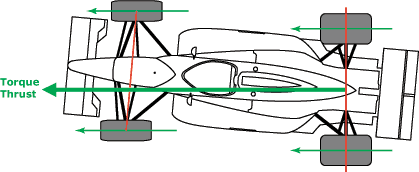
The thrust angle is an imaginary line drawn perpendicular to the rear axle's centerline. It compares the direction that the rear axle is aimed with the centerline of the vehicle. It also confirms if the rear axle is parallel to its front axle and that the wheelbase on both sides of the vehicle is the same.
If the thrust angle is not correct on a vehicle with a solid rear axle, it often requires a trip to the frame straightening shop to correctly reposition the rear axle.
A vehicle with independent rear axles may have incorrect toe-in or toe-out on both sides of the axle, or may have toe-in on one side and toe-out on the other. The suspension on each side of the vehicle must be adjusted individually until it has reached the appropriate toe setting for its side of the vehicle.
An incorrect thrust angle is often caused by an out-of-position axle or incorrect toe settings. So in addition to the handling quirks that are the result of incorrect toe settings, thrust angles can also cause the vehicle to handle differently when turning one direction vs. the other.
993s used a silly kinematic toe adjustment that required both special skill AND a tool to adjust but since '98 all the adjustments are pretty straightforward.
Whoever installed the upper dogbones should have made sure that they were the same length as the OEM non-adjustable units. Although there is an advantage of using the dogbones to gain extra camber and track along with some split lower control arms, 99.9% of us will get more than enough neg camber in the back with the eccentric bolts.
There are hundreds of good alignment spec threads out there but it'll all depend on % track vs street as well as tires you're using. Keep in mind that with the solid bits (especially the toe links) you won't get as much flexing under load and therefore don't need to be silly with how extreme you go. You'll know you have too much toe in if you're wearing the inside of the tires too much and you'll know you don't have enough if the car gets squirrely under hard braking (its because you're forcing toe out and that ain't good).
How do you intend on setting toe and camber yourself?
Check this out for a good explanation of Thrust angle:
Thrust Angle
The thrust angle is an imaginary line drawn perpendicular to the rear axle's centerline. It compares the direction that the rear axle is aimed with the centerline of the vehicle. It also confirms if the rear axle is parallel to its front axle and that the wheelbase on both sides of the vehicle is the same.
If the thrust angle is not correct on a vehicle with a solid rear axle, it often requires a trip to the frame straightening shop to correctly reposition the rear axle.
A vehicle with independent rear axles may have incorrect toe-in or toe-out on both sides of the axle, or may have toe-in on one side and toe-out on the other. The suspension on each side of the vehicle must be adjusted individually until it has reached the appropriate toe setting for its side of the vehicle.
An incorrect thrust angle is often caused by an out-of-position axle or incorrect toe settings. So in addition to the handling quirks that are the result of incorrect toe settings, thrust angles can also cause the vehicle to handle differently when turning one direction vs. the other.
Rennlist Member
Joined: Nov 2003
Posts: 1,237
Likes: 44
From: Sturgeon Falls
Toe links that are adjustable for bump steer use spacers above or below the knuckle to get the link to be as close to parallel with the ground as possible therefore reducing the logarithmic changes in length from the sweep of the arc as the suspension compresses and rebounds.

Instructor
Joined: Sep 2007
Posts: 175
Likes: 1
From: W. Vancouver BC Canada
Grand am spec cars come with a few adjustable pieces, the RSR's come with the whole kit and they ARE used to adjust bump steer, wheel base, ect. here is a link to who has them. http://www.porsche.com/usa/eventsand...ingcomponents/
Rennlist Member
Joined: Nov 2003
Posts: 1,237
Likes: 44
From: Sturgeon Falls
Porsche motorsports sells a solid monoball, non adjustable upper dogbone.
The rear toe links are the adjustable bits.
I can't imagine how the dogbone would help or hurt bump steer. They'd affect camber and track width in conjunction with split lower control arms. Ultimately the toe links control the angle of the wheel and therefor the changes to toe when different forces are applied on the suspension. Same as the tierods do up front. Your lca's and upper strut mount have nothing to do with how the toe changes.
As the range of motion moves the hub within the wheel well, toe invariably increases and decreases (more so when you're trying to maintain camber with multi link suspensions). The more degrees that the toe link sweeps through, the more the toe changes. When the car is lowered, the toe links are moved upward in the arc and are more susceptible to toe changes as a result of suspension loading. The bumpsteer kit uses spacer to move the toe link back to as close to zero (parallel wihthe ground) as possible.
The rear toe links are the adjustable bits.
I can't imagine how the dogbone would help or hurt bump steer. They'd affect camber and track width in conjunction with split lower control arms. Ultimately the toe links control the angle of the wheel and therefor the changes to toe when different forces are applied on the suspension. Same as the tierods do up front. Your lca's and upper strut mount have nothing to do with how the toe changes.
As the range of motion moves the hub within the wheel well, toe invariably increases and decreases (more so when you're trying to maintain camber with multi link suspensions). The more degrees that the toe link sweeps through, the more the toe changes. When the car is lowered, the toe links are moved upward in the arc and are more susceptible to toe changes as a result of suspension loading. The bumpsteer kit uses spacer to move the toe link back to as close to zero (parallel wihthe ground) as possible.

Trending Topics
Rennlist Member
Joined: Sep 2006
Posts: 1,968
Likes: 0
From: Vancouver, BC, Canada
Check out this thread for a partial explanation, or at the very least you'll see Steve Weiner's steps for bump steer that aren't as simple as "use spacers to level the toe link".
 You'll also see that you aren't the only confused fella about this topic when you read the thread.
https://rennlist.com/forums/racing-a...for-track.html
Cheers,

Racer
Joined: Nov 2007
Posts: 316
Likes: 1
From: In the Gearbox, B.C.
atr911,
the spacers on the links "almost" do nothing for bumpsteer (ride height dependant), not even worth to spend the money to bumpsteer the car if that is all the adjustment you have. The pieces Cheyne is talking about are RSR pieces were every link/rod is fully adjustable. This way you can dial in your rear susp. let's for 0-1mm of toe change over a range of 2in. of comp/droop, or whatever settings you want.
BTW.
You can also bumpsteer the front with the right parts.
These pieces are avail. through numerous vendors, just check out tarret, gmg, TRG, etc. they all have them, but $$$$$.
B
the spacers on the links "almost" do nothing for bumpsteer (ride height dependant), not even worth to spend the money to bumpsteer the car if that is all the adjustment you have. The pieces Cheyne is talking about are RSR pieces were every link/rod is fully adjustable. This way you can dial in your rear susp. let's for 0-1mm of toe change over a range of 2in. of comp/droop, or whatever settings you want.
BTW.
You can also bumpsteer the front with the right parts.
These pieces are avail. through numerous vendors, just check out tarret, gmg, TRG, etc. they all have them, but $$$$$.
B
GT3 player par excellence
Lifetime Rennlist
Member
Lifetime Rennlist
Member
Joined: Apr 2002
Posts: 44,033
Likes: 6,734
From: san francisco
atr911,
the spacers on the links "almost" do nothing for bumpsteer (ride height dependant), not even worth to spend the money to bumpsteer the car if that is all the adjustment you have. The pieces Cheyne is talking about are RSR pieces were every link/rod is fully adjustable. This way you can dial in your rear susp. let's for 0-1mm of toe change over a range of 2in. of comp/droop, or whatever settings you want.
BTW.
You can also bumpsteer the front with the right parts.
These pieces are avail. through numerous vendors, just check out tarret, gmg, TRG, etc. they all have them, but $$$$$.
B
the spacers on the links "almost" do nothing for bumpsteer (ride height dependant), not even worth to spend the money to bumpsteer the car if that is all the adjustment you have. The pieces Cheyne is talking about are RSR pieces were every link/rod is fully adjustable. This way you can dial in your rear susp. let's for 0-1mm of toe change over a range of 2in. of comp/droop, or whatever settings you want.
BTW.
You can also bumpsteer the front with the right parts.
These pieces are avail. through numerous vendors, just check out tarret, gmg, TRG, etc. they all have them, but $$$$$.
B
that said, most street GT3's dont sit low enough to really need bump adjusment as these cars dont have nearly the bump issue as 964, 993 and earlier cars.
****, just drive it.

Nordschleife Master
Joined: Dec 2009
Posts: 5,929
Likes: 22
From: Limehouse, ON
Check out this thread for a partial explanation, or at the very least you'll see Steve Weiner's steps for bump steer that aren't as simple as "use spacers to level the toe link". You'll also see that you aren't the only confused fella about this topic when you read the thread.
https://rennlist.com/forums/racing-a...for-track.html
Cheers,
You'll also see that you aren't the only confused fella about this topic when you read the thread.https://rennlist.com/forums/racing-a...for-track.html
Cheers,
Thanks for the link Allan. Looking forward to reading it when I get home.
Rennlist Member
Joined: Nov 2003
Posts: 1,237
Likes: 44
From: Sturgeon Falls
Likewise... I am yet again shown how little I know.
In fairness Francois, the bumpsteer adjustment on your rear links will work fine for most applications. It's how Gianni sets cars up and if it's good enough for him, I'm sure I'll be fine. Remember, even the cup cars come with non adjustable upper links. It's only the RSRs that have the completely adjustable suspension geometry.
In fairness Francois, the bumpsteer adjustment on your rear links will work fine for most applications. It's how Gianni sets cars up and if it's good enough for him, I'm sure I'll be fine. Remember, even the cup cars come with non adjustable upper links. It's only the RSRs that have the completely adjustable suspension geometry.
Rennlist Member
Joined: Sep 2006
Posts: 1,968
Likes: 0
From: Vancouver, BC, Canada
It all depends on how **** you want to be. Bernie knows this stuff inside and out. He's the chief mechanic for a Rolex 24 Cup Car team and is the guy setting up my car. 
fwiw, once upon a time a fella (not Bernie) checked the toe changes on the rear of my car and found with spacers installed to make the toe links parallel to the ground, the toe would move out by 11 mins when the rear was raised 1". The toe would move in by 14 mins when the rear was compressed by 1". Without spacers (leaving the toe links non-parallel to the ground), the toe would move out 6 mins when the rear was raised 1" and would move in 4 mins when the rear was compressed by 1". Much better.
The idea to always use spacers to make the toe links parallel to the ground is flawed. Your specific car should be checked if this area concerns you.
The "proper" way to adjust bump steer like what Bernie, Cheyne, Steve Weiner, etc do will do a much better job of keeping toe changes minimized as the suspension moves through its range. However, this requires the right suspension pieces and time intensive procedure to do this correctly.
In the end, whether your toe moves a little or a lot may not matter too much to a regular driver. Worst case, your car becomes a little loose when pushing it in a corner. Learn how to drive and it won't matter much. Or just dial it back a bit.
As Mooty says "****, just drive it".
Cheers,
fwiw, once upon a time a fella (not Bernie) checked the toe changes on the rear of my car and found with spacers installed to make the toe links parallel to the ground, the toe would move out by 11 mins when the rear was raised 1". The toe would move in by 14 mins when the rear was compressed by 1". Without spacers (leaving the toe links non-parallel to the ground), the toe would move out 6 mins when the rear was raised 1" and would move in 4 mins when the rear was compressed by 1". Much better.
The idea to always use spacers to make the toe links parallel to the ground is flawed. Your specific car should be checked if this area concerns you.
The "proper" way to adjust bump steer like what Bernie, Cheyne, Steve Weiner, etc do will do a much better job of keeping toe changes minimized as the suspension moves through its range. However, this requires the right suspension pieces and time intensive procedure to do this correctly.
In the end, whether your toe moves a little or a lot may not matter too much to a regular driver. Worst case, your car becomes a little loose when pushing it in a corner. Learn how to drive and it won't matter much. Or just dial it back a bit.
As Mooty says "****, just drive it".
Cheers,
