When you click on links to various merchants on this site and make a purchase, this can result in this site earning a commission. Affiliate programs and affiliations include, but are not limited to, the eBay Partner Network.
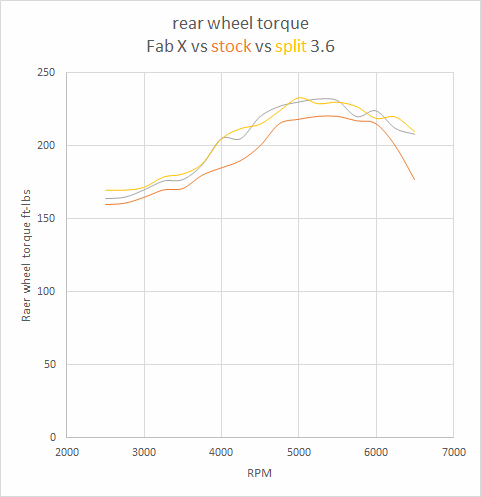
here is a comparison of a stock 993 exhaust in red and 2 cat by pass systems, the Fabspeed merge is in yellow, a non merged in gray
Toy can see that either cat bypass is better than stock , I don't car for the Fabspeed as the resonances the merge induces don't seem to be as helpful as those on the separated system., both go to modified stock 993 side mufflers and both have chips for the setups.
Always great to have Bill’s encyclopedic input. Glad to be back in the 993 rennlist community. I’m still awaiting final tuning/dyno session with the new exhaust. I completely expect to lose some top end HP with this setup vs the straight pipe/valved GT3 setup. Since I’ll have dyno runs with both setups, it won’t be conjecture. I’ll have the data. Maybe, I’ll just keep the Dawe exhaust with the car in case the next owner (down the road) prefers it (or if I get stupid and get the track bug again). Plus, this car is putting out some crazy HP and torque numbers with that setup. We’ll see. But I was married to the center exit exhaust after all the bumper work and in the spirit of this stealth outlaw build. In truth it’s also just bad ***… so looks, sound, performance, and every day drivability (including heat and minimizing obnoxious no-cat exhaust odor) were all factored in.
Last edited by ninjabones; Apr 8, 2024 at 09:35 PM.
Also, Bill, did you mix that up in your last post? You said Fabspeed in yellow, non-merged (split) in grey but the color coding on the header of the chart shows it the other way around. Fabspeed in grey, split in yellow.
@Bill Verburg
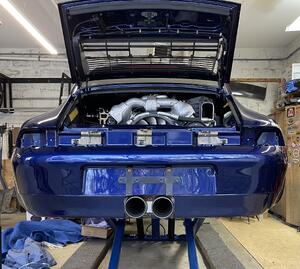
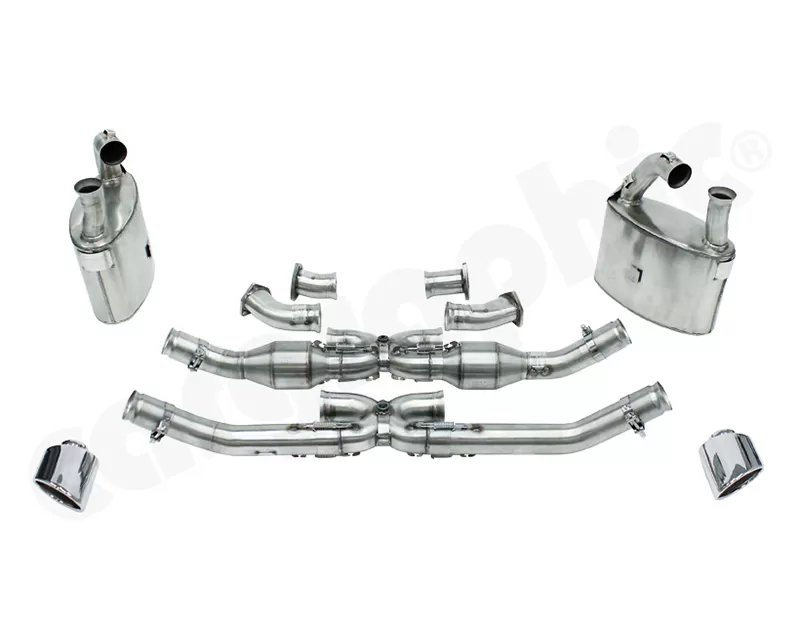
wrt Cargraphic exhaust pictured here
45mm ID primary is a good size for 3.6 to 4.0 under 7200rpm How does this compare to the 42mm ID ( considering that option since it has larger heat exchangers) ?
the merge after the primary does little to nothing for power/torque on an even fine motor like a 911, in this application it is mostly for sound attenuation Are you saying a reduction in sound pitch or volume or both ?
the merge here is also poorly located as is the 90° bend Will it loose power/torque over stock due to this poor location ?
again for a street oriented motor stock header/heat exchanger w/ non merged cat bypass and modified stock muffler is the best bang for the buck, even the best headers on a muffled system are not going to give anywhere near the results that they do when opened up w/o anything but properly spec'd open pipe after the collector You saying the same as Colin- difficult to best the stock headers for a street motor ?
Also, Bill, did you mix that up in your last post? You said Fabspeed in yellow, non-merged (split) in grey but the color coding on the header of the chart shows it the other way around. Fabspeed in grey, split in yellow.
yes, I was dizzy from a long bike ride and a few beers while watching the eclipse
@Bill Verburg
wrt Cargraphic exhaust pictured here
45mm ID primary is a good size for 3.6 to 4.0 under 7200rpm How does this compare to the 42mm ID ( considering that option since it has larger heat exchangers) ?
the merge after the primary does little to nothing for power/torque on an even fine motor like a 911, in this application it is mostly for sound attenuation Are you saying a reduction in sound pitch or volume or both ?
the merge here is also poorly located as is the 90° bend Will it loose power/torque over stock due to this poor location ?
again for a street oriented motor stock header/heat exchanger w/ non merged cat bypass and modified stock muffler is the best bang for the buck, even the best headers on a muffled system are not going to give anywhere near the results that they do when opened up w/o anything but properly spec'd open pipe after the collector You saying the same as Colin- difficult to best the stock headers for a street motor ?
The goal is to keep exhaust velocity as high as possible for the longest time possible. how to do that depends on lots of things
primary diameter is one of them, ideally you would have pipes that expand in cross sectional area as revs rise. This is not gonna happen so you choose a size that complements the usage and engine specs, For street use most of the time you are in the 3500 to 5500 rpm range so for a 3.6 or 3.8 42mm is probably a better choice than 45mm, but for track use where you are in the 5500 to 7000 range 45mm will be better.
I've used multiple different exhaust setups on my 2 993 powered cars.
stock 993 header/heat exchanger compares favorably to properly sized equal length headers when mufflers are used.
38mm is too small above 3500rpm for a 3.2 let alone a 3.6
mufflers design makes a huge impact when they are used.
a properly implemented merge cat by pass can attenuate noise levels w/o adversely affecting flow but most are not done as well as they could be, they generally place the merge where it's convenient for packaging or fabrication and usually pay little attention to the actual affect that they have on flow and acoustic reflections in the system. what the merge does is split the noise between 2 mufflers instead of one, effectively doubling the attenuation volume. W/ mufflers the bigger the volume the better.
On front engine rear drive v8s w/ odd fire engines a merge is absolutely a necessary and beneficial feature for max performance muffle or not, On these there is plenty of room to have the pipes come together and merge flow w/o disruption. Though a smooth merge is best an H in these systems is almost as good, placement and details are not critical.
When using headers a similar situation occurs in the collector where a smooth merge of the separated primaries in very beneficial, it takes time and skill to implement this sort of strategy.
@Bill Verburg
The internal diameter on stock manifolds 38mm ?
For a street use 3.8 that already has cams, solid lifters, 200 cell cats and sport mufflers, are there any noise/performance gains changing the stock manifold with the Cargraphic 42ID headers ?
yes, I was dizzy from a long bike ride and a few beers while watching the eclipse
Fabspeed merged is grey and separated is yellow
Looks like separated is the way to go! That's what I've been running for the last 10 years (Cargraphic 100cell separated pipes) and was itching to switch to X-pipes. Glad I didn't and saves quite a few bucks!
@Bill Verburg
The internal diameter on stock manifolds 38mm ?
For a street use 3.8 that already has cams, solid lifters, 200 cell cats and sport mufflers, are there any noise/performance gains changing the stock manifold with the Cargraphic 42ID headers ?
no that was just the ID of a set of headers i had laying around and tried, believe it or not some street only guys like the 38s for the throttle response at low speed
here's some interesting(to me) facts
@6800rpm
that's 113rps
each cyl fires 57 times /s
there are 170 pulses /s in each sides manifold
residence time is .00965s to exit the collector
pulses are .0059s apart
there is 1.6 pulses in each pipe at a given instant of time
the acoustic rarefaction signal that enhances exhaust scavenging is sent whenever there is a sudden change on pipe cross sectional area, it's magnitude is proportional to the size of the change, which is why open headers are soooo good when there is cam timing overlap and the geometry of the pipes is right, tapered collector extensions can massage that signal to enhance hp /torque
9 Vehicles Porsche Helped Engineer that Aren't Porsches
Slideshow: Long before engineering consulting became trendy, Porsche was quietly helping other automakers build everything from supercars to economy hatchbacks.
9 Features and Characteristics That Only Porsche People Understand
Slideshow: Some brands build cars. Porsche builds traditions, obsessions, and a few habits that stopped making sense decades ago but somehow became part of the charm.
This Builder Is Turning Heads With Its Slantnose 911 Creation
Slideshow: A small Polish tuner has reimagined the Porsche 911 Slantnose for the modern era, blending 1980s nostalgia with widebody tuning culture and serious performance upgrades.
Porsche 911 GT3 Artisan Edition Pays Homage to Japanese Culture
Slideshow: Porsche has created a Japan-only 911 GT3 Artisan Edition that blends track-ready hardware with design cues inspired by traditional Japanese craftsmanship.
Porsche Reveals Coupe Variant of the Electric Cayenne With a Fresh Look
Slideshow: Porsche's latest electric Cayenne Coupe blends dramatic styling with supercar acceleration, turning the brand's midsize SUV into a 1,139-horsepower flagship.