When you click on links to various merchants on this site and make a purchase, this can result in this site earning a commission. Affiliate programs and affiliations include, but are not limited to, the eBay Partner Network.
Here is the situation:
replace fuse 12. It will blow with seemingly no patterns and randomly after about 24 hours.
Prior to it blowing everything on that fuse works fine
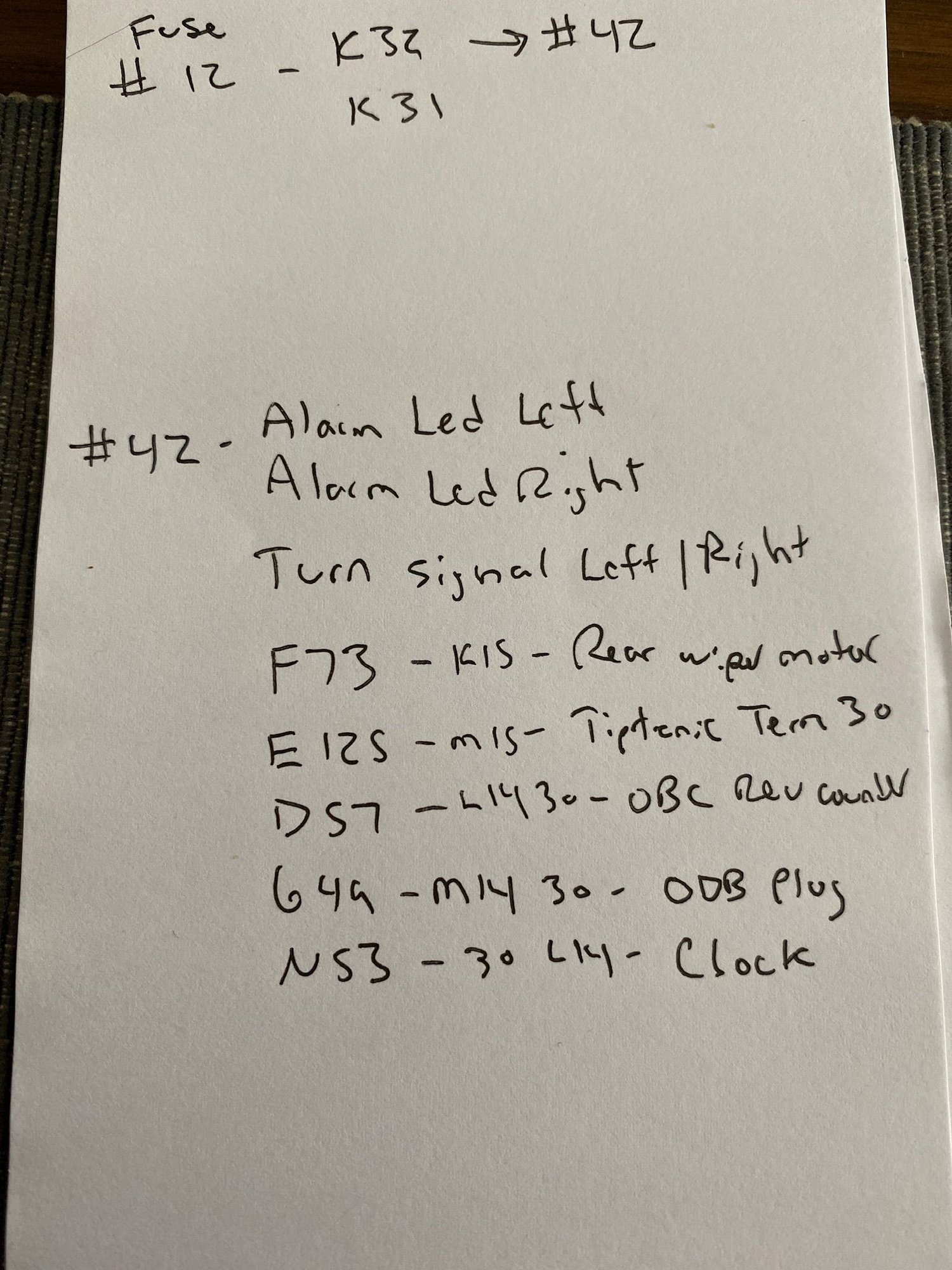
when it blows the things in the attached do not work
the car is a manual and does not have rear wiper and no obc
the attached notes are from the 95 wiring diagram. If anyone has a 98 diagram with any noted differences that would be great if you could share
the flashers are the alarm light flashers In the notes
immobilizer works fine and locks unlocks car as it should
the car is very original and stock not molested
what i have tried
1. Removed clock and swapped clock for a known good one
2. Unplugged the door leds
i have not yet tried removing or swapping the lock module.
further the very intermittent nature I’m not sure impedance checks will help but i can try that next from the fuse to the end points.
any ideas? Very frustrating as the main noticeable issue when the fuse blows is the clock stops and the flights done flash on arming alarm and door leds do. It flash
Hi Spyerex,
If you speak of the fuse in the engine compartment it appears it powers among other things the rear window defroster. There is a hot wire that powers the window defroster and it may be the issue. The easiest way to test it is to remove the few screws holding the inside rear window deck and disconnect the plug to the window heating grid. The wire to it can be inspected for grounding and reinsulated or the wire replaced.
Also, you may want to look at the connection points to the grid on the very edges of the glass to see if they are grounding out to the body window opening.
Andy
Hard short in a device that is not turned on all the time. E.g turn signals, rear defroster, etc. But I assume you've tried all those and can't reproduce the failure?
Continual heavy leakage through some device that is drawing too much current - causing the fuse link to overheat but not blow. Until heat/metal fatigue finally takes it out. This could be checked with a trouble light or ammeter on the downstream side of the fuse socket.
Intermittent wiring harness short that happens due to some event - vibration, road bumps, etc.
If you can't find it any other way, I'd be tempted to build a "fuse blow notifier." Remove the clock and replace with a light bulb wired to the clock +12 so he can hopefully notice exactly when it blows and tie it to some event. For real overkill, that light could be tied to a normally closed relay so that it comes ON when the fuse blows.
One other thought, just because there is no OBC or Tip, doesn't mean there are not unused wires & connectors in the harness. If these weren't tied off well they could fray and short intermittently. I point this out because on my Tip I found just such a situation - a wire and connector poorly taped to another cable next to my transmission. Research showed it to be the unused backup light switch for a manual gearbox car. Possibly because when they issued the engine harness recall they only made one replacement harness to fit all cars?
What a PITA. I have dealt with electronic issues and they are extremely frustrating.
Another easy check for you would be to remove the steering wheel and check the wiring from the clock spring. There are several wires connected in there and some control the turn signals. IIRC, there are two ground wires in there and if one is loose that could cause the issue.
If you speak of the fuse in the engine compartment it appears it powers among other things the rear window defroster.
Sorry wasn't clear, it's fuse #12 in the Frunk, not rear of car. This circuit is not connected to the rear defroster. I'm familiar with that/those wires from reinstalling a rear windshield on my 964! it's a PITA!
Originally Posted by jrmdir
Process of elimination:
Hard short in a device that is not turned on all the time. E.g turn signals, rear defroster, etc. But I assume you've tried all those and can't reproduce the failure?
Continual heavy leakage through some device that is drawing too much current - causing the fuse link to overheat but not blow. Until heat/metal fatigue finally takes it out. This could be checked with a trouble light or ammeter on the downstream side of the fuse socket.
Intermittent wiring harness short that happens due to some event - vibration, road bumps, etc.
If you can't find it any other way, I'd be tempted to build a "fuse blow notifier." Remove the clock and replace with a light bulb wired to the clock +12 so he can hopefully notice exactly when it blows and tie it to some event. For real overkill, that light could be tied to a normally closed relay so that it comes ON when the fuse blows.
One other thought, just because there is no OBC or Tip, doesn't mean there are not unused wires & connectors in the harness. If these weren't tied off well they could fray and short intermittently. I point this out because on my Tip I found just such a situation - a wire and connector poorly taped to another cable next to my transmission. Research showed it to be the unused backup light switch for a manual gearbox car. Possibly because when they issued the engine harness recall they only made one replacement harness to fit all cars?
The blown notifier is the clock :-) It logs exactly what time it blows! The problem is it's entirely inconsistent.
I should be clear on my notes as I was struggling to follow all the paths on my iPad using the 'highlight' feature to map all the wires :-) :
It's not the "turn signals" its actually a wire that goes to the Alarm control module that feeds the flashing lights. When the fuse is blown the hazards and turn signals function properly. However, when you arm or disarm or set the alarm off, the lights do not flash. From looking at the wiring diagram, Fuse #12 powers a switch relay or circuit in the alarm control module to enable the flashing. That said, when fuse12 is blown, the alarm/immobilizer works other than the flashing light or door LEDs.
We traced all indicated circuits and based on my notes, they seem right on what doesn't work when the fuse is blown.
On your #2, I think that is a good idea. I actually put my meter across the fuse and it was very very low (maybe 20-30ma) with the clock plugged in...
Unfortunately, I think it may be #3
And yeah, I am pretty sure most of the wires are in the harness. That is my worry it's a short somewhere and I'm not about to start ripping my buddies car apart chasing the harness!!!
Originally Posted by Chuck W.
What a PITA. I have dealt with electronic issues and they are extremely frustrating.
Another easy check for you would be to remove the steering wheel and check the wiring from the clock spring. There are several wires connected in there and some control the turn signals. IIRC, there are two ground wires in there and if one is loose that could cause the issue.
Good luck and keep us posted.
Yeah I'm pretty sure it's not the steering wheel/clock spring/turn signals (see note above) unless there is some cross circuit there that would cause this.
I think next steps:
going to connect amp meter on the fuse again and check draw
wire up a continuity from the fuse block to the end points and see if any look 'off' and also test to ground for any leakage
swap out the alarm module for a known good one (he has another 993)
Thanks for the update - sounds like you have a good plan. Thanks also for clarifying the turn signal on your list not being the actual turn signals - which have their own fuses.
As far as chasing harness issues I think you have a more contained situation than I first thought. Unless there's some rouge circuit that's on #12 but not listed anywhere, then all of the suspects are in a fairly small area - which makes sense as a whenever possible a wiring harness branch off of a fuse would be routed to a specific area. In this case we have:
Behind the clock and tach (Clock, OBC connector)
Console (OBD, rear wiper switch and probably the unit that flashes the lights and leds)
These are not high vibration harsh environments for wiring but you never know. If you can find that flasher module I'd try disconnecting it as a first step in isolating the issue.
Also pull the console switches and make sure the rear wiper connector isn't the culprit. (Every time I remove and replace those switch panels it seems like I'm cramming the wires back in to make it fit.)
Also pull the console switches and make sure the rear wiper connector isn't the culprit. (Every time I remove and replace those switch panels it seems like I'm cramming the wires back in to make it fit.)
Just a thought.
"the car is a manual and does not have rear wiper and no obc"
Has anything been fixed or replaced recently on the vehicle?
Is the replacement fuse the correct size?
Have any resistive loads such as a bulb inside or outside the car or in the dash been replaced? A defective new bulb may draw too much current or the sum of a group of bulbs that draw a bit too much. Bulbs can be checked with an Ohm meter.
Formula:
Current Formula: Amps = Volts/Ohms Resistance, for example:
12 Volts / 24 Ohms
=0.5 Amps
So a bulb that reads 24 ohms on a meter draws half an amp at 12 volts.
Have any new bulbs been added, such as behind the rear reflector, a common upgrade?
Has the bulb socket in the lid of the frunk begun to intermittently ground out? I had this issue.
With the fuse in consider reading the voltage drop across the fuse pins and look up the associated maximum drop such a fuse size and type lists on the below chart to determine if the issue is a constant high load or an instantaneous overload. One can also rig up a small 12-volt piezoelectric buzzer (eBay item) across the fuse that will alarm when the fuse blows alerting one to any coordinated event that precipitated the blowing of the fuse. A few dollars on eBay. Voltage Drop Chart
Just FYI but bulb resistance increases greatly when illuminated due to the temp of the filament. Measuring them cold at micro amps from an ohmmeter will give much lower resistance. You can just wire them to the battery to check but I’ve never seen a bulb pull the wrong current.
Well... the issue continues. However, now the issue happens immediately that is, fuse 12 will blow immediately on replacement. That's good right? Easier to track down:
What did we try:
pulled up fuse block
Removed harness plugs from bottom
Tested continuity on the K31/32 wires
Verified the hot from power to fuse is OK
The K31/32 wires are shorted to ground with less than 2 ohms, so a hard short
We verified all end points are OK except alarm module (not yet tested)
So next step:
Pull alarm module to see if fuse continues to blow
Remove center console in front of shifter where ODB2 plug is and trace wiring
The problem here is, its either an end point (i listed them in my note, but we've checked most of them), or it's in the harness somewhere. The car is very clean, not modded, no aftermarket crap. All the wiring i can see looks OK. Last resort is to rip interior apart and trace harness... UGH.
I have a sneaking suspicion its the alarm module hot power that I believe powers the flashing lights when the alarm is going off.
The F12 loads you listed in post 1 are correct per the 98 schematic. In addition to your next steps of pulling the alarm module and center console, you might try one other thing. The door LED circuits pass thru two 10 pin connectors X11/2 and X12/2 located at 6cQ and 6cL (under dash/driver's side and passenger side). Unplugging these will take a little more of the LED circuit out of the picture. It's a longshot but if the short disappears you'll know it's between those connectors and the door LED. Everything else you did is good.
The F12 loads you listed in post 1 are correct per the 98 schematic. In addition to your next steps of pulling the alarm module and center console, you might try one other thing. The door LED circuits pass thru two 10 pin connectors X11/2 and X12/2 located at 6cQ and 6cL (under dash/driver's side and passenger side). Unplugging these will take a little more of the LED circuit out of the picture. It's a longshot but if the short disappears you'll know it's between those connectors and the door LED. Everything else you did is good.
ok great thank you. I will try that in addition to pulling the module.
if that’s not it will have to break out the schematic and locate all the plugs and test each section. He’s a good buddy but need to determine if he’s that good a buddy LOL
im not an expert on the 993 or reading these schematics. Do you know where the main harness runs? I could give a look i guess but i habe a feeling it’s near an endpoint or one of the plugs
The schematic describes the X11/2 and X12/2 connectors as "under the dashboard" so I assume they're accessible without difficulty. According to the schematics, the 6cQ and 6cL locations are to the far right and far left under the dashboard. It's worth a quick check before going to the trouble of taking the seat out and swapping Alarm Control units. Also, since your initial post reported that the short was intermittent (now permanent) It favors a fault in wiring that "moves" (door hinge) rather than a fault in the rest of the F12 net which is immobile. A hard fault inside the ACU is less likely, especially an intermittent one. If you can't find the connectors let me know and I'll have a look in my 97.



 Help with seemingly random fuse 12 blowing