When you click on links to various merchants on this site and make a purchase, this can result in this site earning a commission. Affiliate programs and affiliations include, but are not limited to, the eBay Partner Network.
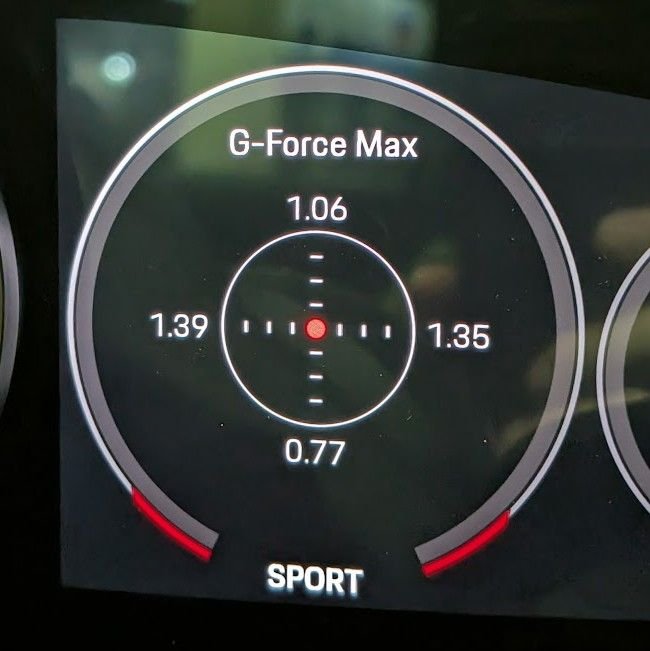
I have a 992.1 S with PASM, Rear Active Steering and Sport Chrono. I have made no modifications to the car, and am running the stock summer tires. Here are my current high scores:
My unmodified 992.1 T with PASM and Sport Chrono, but without RAS, got almost identical lateral numbers running on the stock tires. I thought that RAS would materially decrease the lateral limits because you are not fighting friction (sliding) as much, so I found that result to be interesting. I absolutely sense the difference between the standard rear axle and RAS when in tight turns, slow and fast. It is certainly not as raw as the standard axle, where you can feel like you are dancing on the edge of adhesion, but that added sense of control makes me more willing to push harder in turns. I also wonder/worry about the complexity of the RAS system, and also whether it adds any material weight to the rear of the car changing the weight balance. Though I have only had this car about 4 months, I am already thinking about my next 911 and thinking about whether I would get RAS again, and that leads to my question: Do people who have had RAS get it on their next 911, or do they go back to the standard rear axle? Thanks.
Yes, it adds some weight. You also lose some rear end feedback. Personally, I prefer the feel without RAS, but YMMV. I wouldn’t expect it to make any notable difference in the lateral Gs that you experience.
Last edited by detansinn; Jan 26, 2026 at 09:36 PM.
I am not sure you'd see any effect from RAS in those numbers, unless you were going in circles under 30 mph?
Under 30 mph, rear wheels counter steer, reducing the turning radius. Makes it easier to park and do tight turns.
At high speeds >50mph rear wheels parallel steer when you move laterally. So your steering inputs are smaller and car basically mini crab walks between lanes.
RAS works great at two things I described above. Unless someone corrects me, I don't think RAS would help at pulling sustained Gs in high speed turns.
[QUOTE
I also wonder/worry about the complexity of the RAS system, and also whether it adds any material weight to the rear of the car changing the weight balance. Though I have only had this car about 4 months, I am already thinking about my next 911 and thinking about whether I would get RAS again, and that leads to my question: Do people who have had RAS get it on their next 911, or do they go back to the standard rear axle? Thanks.[/QUOTE]
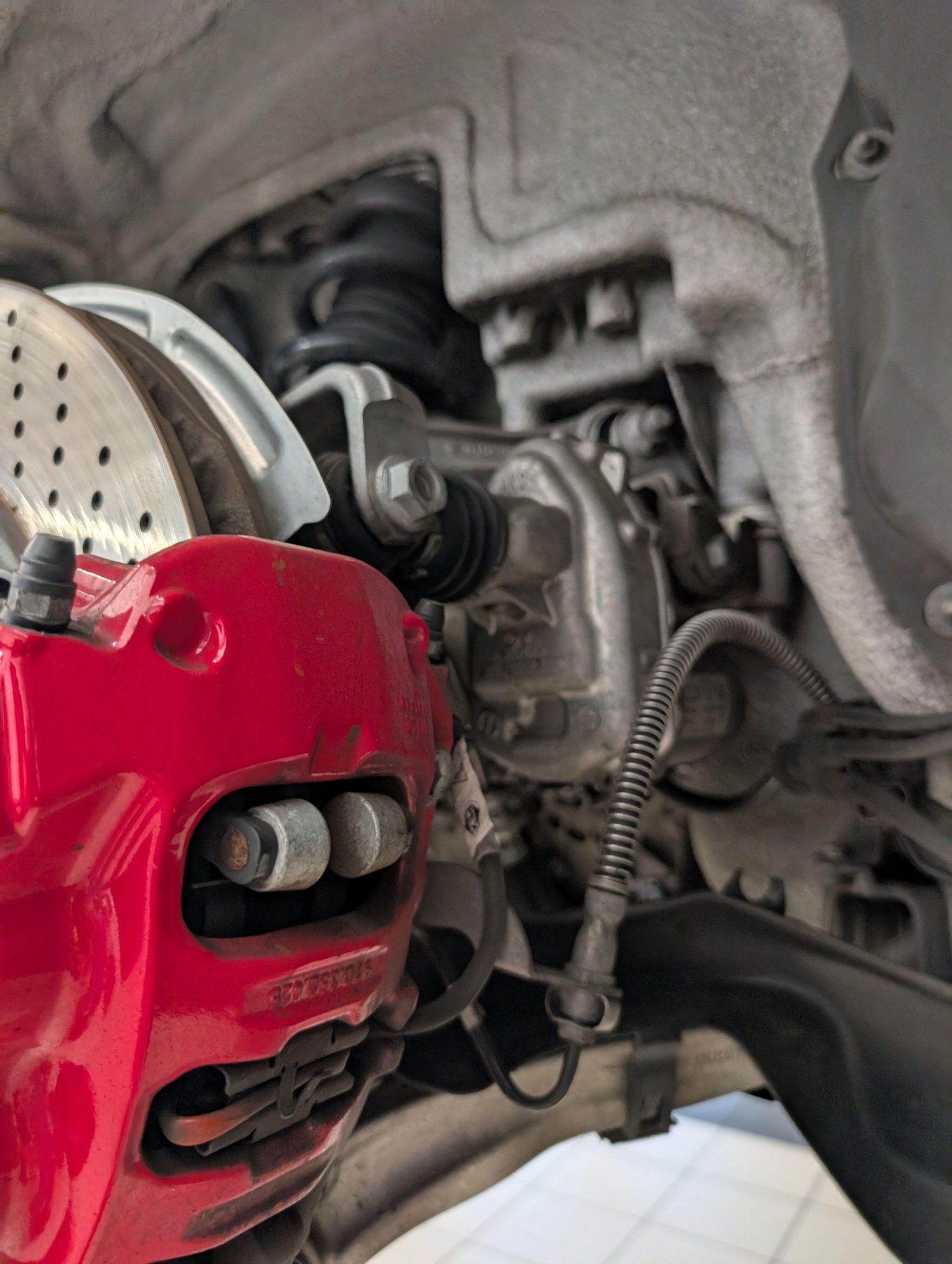
I took some pictures of a 992.1S with RAS while dropping of the car for windshield replacement at the Porsche Dealership. Our 2022S Coupe MT has RAS (our 997.1 C4 MT doesn't of course), so I'm only comparing a 2WD with RAS to an AWD w/o RAS.
This is the right rear wheel of the vehicle. I think the additional weight is in the 20 lb range (10 lbs/side) for the actuator and attachment points.
How much weight does it add? I’m guessing very little. And anytime something produces high speed stability, I call that performance. Here is an old YouTube explanation:
I recall reading somewhere that the actual option weight for RAS was listed at around 14 lbs total.I ordered my 992.1 T with RAS. It was my first 911, so I didn’t really know any better at the time. Like others have said, it makes the rear end feel more planted and gives you more confidence in corners. I’ve pushed through some tight twisties at very questionable speeds and the car felt absolutely glued. Was that the RAS? Maybe.
That said, considering the 992.2 T and the GT3 both come standard with RAS, I’m inclined to think Porsche’s engineers know a thing or two about how to make these cars carry serious speed into a corner.
RAS decreases the low speed turning circle and increases high speed stability. It is for convenience and safety, not performance. Do your homework.
How is the increasing of high speed stability not a "performance" enhancement? That is one of the issues that I am asking about, so I would like to understand your comment. As I said in my initial post, I feel the stability and it makes me more comfortable pushing the car harder. But I also feel like it numbs the experience a bit because the rear end does not respond the way that I am used to.
I recall reading somewhere that the actual option weight for RAS was listed at around 14 lbs total.I ordered my 992.1 T with RAS. It was my first 911, so I didn’t really know any better at the time. Like others have said, it makes the rear end feel more planted and gives you more confidence in corners. I’ve pushed through some tight twisties at very questionable speeds and the car felt absolutely glued. Was that the RAS? Maybe.
That said, considering the 992.2 T and the GT3 both come standard with RAS, I’m inclined to think Porsche’s engineers know a thing or two about how to make these cars carry serious speed into a corner.




 Thoughts on RAS