When you click on links to various merchants on this site and make a purchase, this can result in this site earning a commission. Affiliate programs and affiliations include, but are not limited to, the eBay Partner Network.
I had my winter tires fitted yesterday and requested 32 PSI on the fronts and 35 PSI on the rears. When I drove away I used the TPMS to check pressures and they came in at 26 PSI on the fronts and 30 PSI on the rears.
rears. Checking now with my pressure gauge they are showing 32 PSI and 35 PSI but still the lower values on the TPMS. Which should I trust? My gut is that if the tire shop and my gauge are both showing 32 and 35 I should be good and there's something up with the TPMS. Maybe it doesn't read right at 10,700 feet altitude where I am. Or should I add air and rely on the TPMS reading?
I have several tire pressure gauges, some are actually rather expensive and supposedly extremely accurate ones. None of them agree perfectly with each other and none of them agree perfectly with the TPMS system on my 911. One can get a bit OCD about this sort of thing.
The temperature of the tire and thus the air temperature of the air inside the tire can cause the tire pressure to fluctuate wildly. If the air in the tire has a significant amount of moisture in it, (humid air) that will exacerbate this fluctuation. When racing, folks will use dry nitrogen to fill their tires. Nitrogen isn't what's important, it's the "dry" part that makes it desirable so that the tire pressures are more easily and accurately managed.
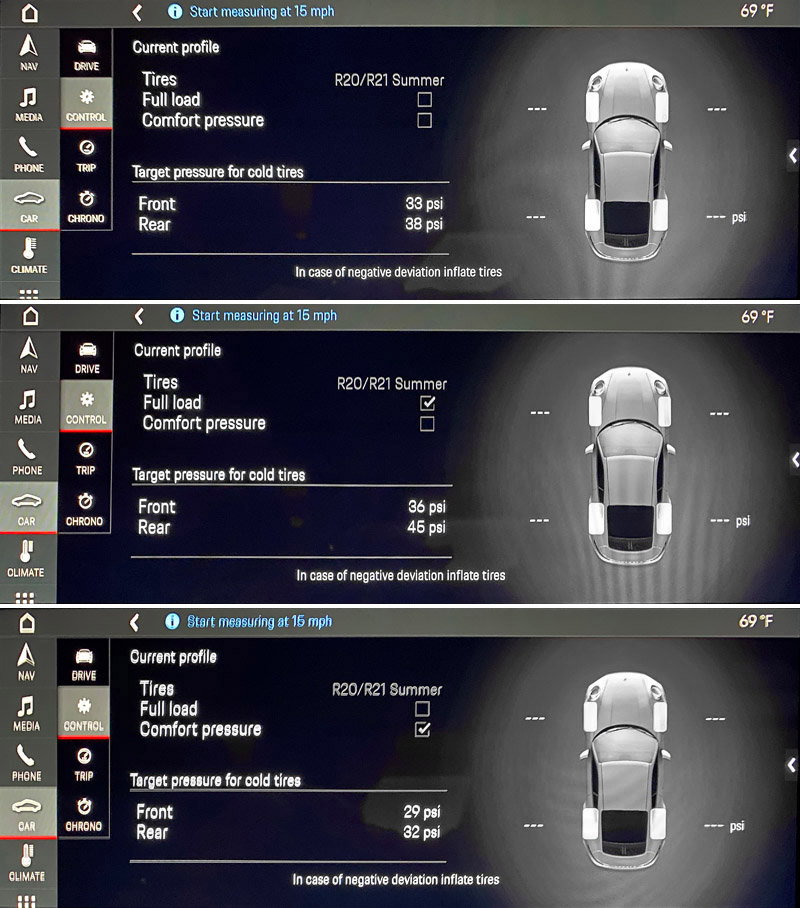
There are three different tire pressure settings (see below) that you can tell the computer (PCM) on the car to look for. If the computer is looking for one of the three settings and the tire pressures have been set to one of the other two settings, the computers programming will see that as a fault. So make sure that what you want and what the computer wants are the same thing.
Finally, the computer (PCM) doesn't actually "read" the tire pressures until the car is moving (15+ mph I think). So anything you see displayed when moving at less than this speed may or may not be accurate. Any reading other than "---" below 15 mph is history.
Readings taken at similar temps and TPMS reading taken on the move. Computer set for the correct tires.
Given the tire shop and my gauge seemed to read the same I am just surprised there is such a big discrepancy between those and the TPMS. 5 or 6 PSI seems pretty significant. Given low winter temps are on the way I really don't want to be significantly too low or high. I have the car booked in for it's first service in a couple weeks so I think I'll get the dealer to check this out and see what they have to say.
I have several tire pressure gauges, some are actually rather expensive and supposedly extremely accurate ones. None of them agree perfectly with each other and none of them agree perfectly with the TPMS system on my 911. One can get a bit OCD about this sort of thing.
The temperature of the tire and thus the air temperature of the air inside the tire can cause the tire pressure to fluctuate wildly. If the air in the tire has a significant amount of moisture in it, (humid air) that will exacerbate this fluctuation. When racing, folks will use dry nitrogen to fill their tires. Nitrogen isn't what's important, it's the "dry" part that makes it desirable so that the tire pressures are more easily and accurately managed.
There are three different tire pressure settings (see below) that you can tell the computer (PCM) on the car to look for. If the computer is looking for one of the three settings and the tire pressures have been set to one of the other two settings, the computers programming will see that as a fault. So make sure that what you want and what the computer wants are the same thing.
Finally, the computer (PCM) doesn't actually "read" the tire pressures until the car is moving (15+ mph I think). So anything you see displayed when moving at less than this speed may or may not be accurate. Any reading other than "---" below 15 mph is history.
.
I don’t understand the first view above where both Full Load and Comfort Pressure are left unchecked. I thought I read my manual correctly that the Front - 36psi and the Rear - 38 psi were “comfort”. I don’t recall reading anything in the manual referencing Comfort being Front - 29 psi and Rear 32 psi.
I don’t understand the first view above where both Full Load and Comfort Pressure are left unchecked. I thought I read my manual correctly that the Front - 36psi and the Rear - 38 psi were “comfort”. I don’t recall reading anything in the manual referencing Comfort being Front - 29 psi and Rear 32 psi. This is confusing.
Yea, Porsche doesn't make it real clear, that's for sure. When both boxes are unchecked, it's (for lack of a better word) the "Normal" tire pressure settings. If you look at what are listed as the "Target pressure for cold tires", you can see how NOT checking either one of the two boxes, puts the Target pressures (F=33, R=38) right between what checking either one of the two boxes will give you.
Last edited by Bluehighways; Oct 4, 2022 at 11:32 PM.




 Tire pressure deviation