When you click on links to various merchants on this site and make a purchase, this can result in this site earning a commission. Affiliate programs and affiliations include, but are not limited to, the eBay Partner Network.
I liked the days when you could get different color brake fluid which made it VERY easy to see when it was flushed. And you could just alternate colors when doing flushes.
I take my Mercedes E63s to an indy shop and they check the brake fluid. They mentioned that there was 0% water when they tested and suggested I just wait another year to revisit a brake fluid change. Similar story for our X3, the fluid tested at 0% water so they were not pushing a brake fluid change. Neither the E63 or X3 see the track.
I change the fluid in the 911 at least every 2 years, and if doing several track days in the summer will make sure it has been changed just before the events.
As usual with Porsche, one-size-fits-all service recommendations are more aimed towards keeping the dealership's service bays busy than actual need. The problem with old brake fluid is it becomes contaminated (from water vapor) which lowers its boiling point. But a garage-kept weekend warrior in a dry climate is much less likely to be contaminated than a daily driver in a humid climate.
Buy a moisture checker and check it yourself. Seriously, here's one on Amazon for six bucks.
There are fancy versions available if that's too cheap for you. My weekend-driven garage-kept 911 is still showing 0% with four year old brake fluid, there is zero reason to change it other than helping put the Porsche Service Advisor's kid through college. Of course if you track or otherwise beat your car up then check it and change it more often.
Bottom line is this, aside from things that naturally age (like hoses and belts), many of Porsche's time-based service intervals are a waste of money. They are intended to get low mileage cars into the dealership to rack up unneeded service charges. Spark plugs don't spoil like a loaf of bread after four years either.
As usual with Porsche, one-size-fits-all service recommendations are more aimed towards keeping the dealership's service bays busy than actual need. The problem with old brake fluid is it becomes contaminated (from water vapor) which lowers its boiling point. But a garage-kept weekend warrior in a dry climate is much less likely to be contaminated than a daily driver in a humid climate.
Buy a moisture checker and check it yourself. Seriously, here's one on Amazon for six bucks.
There are fancy versions available if that's too cheap for you. My weekend-driven garage-kept 911 is still showing 0% with four year old brake fluid, there is zero reason to change it other than helping put the Porsche Service Advisor's kid through college. Of course if you track or otherwise beat your car up then check it and change it more often.
Bottom line is this, aside from things that naturally age (like hoses and belts), many of Porsche's time-based service intervals are a waste of money. They are intended to get low mileage cars into the dealership to rack up unneeded service charges. Spark plugs don't spoil like a loaf of bread after four years either.
Couldn’t agree more. In fact I think over-servicing causes more problems than it prevents.
Old fluid is generally dirty and darker than new fluid. If you use clear tubing on the bleeder valve going into a catch bottle, you can see the change pretty easily when the new displaces the old.
And the interesting finding is, the fluid you took directly from the reservoir still looked yellowish in color, almost like new. What's causes the difference to the greenish-brown fluid that came out of the calipers ? It is the water content.
If you measure the water contamination (by its electric conductivity, and I did it) you find the color changes with the water contamination. 3 % water changes your light yellow brake fluid a green to brown color.
And yes, taking a sample from the reservoir does not tell you what is in the calipers, and what may happen if you drive down a mountain road. For those who rely on testing the fluid in the reservoir, good luck !
And the interesting finding is, the fluid you took directly from the reservoir still looked yellowish in color, almost like new. What's causes the difference to the greenish-brown fluid that came out of the calipers ? It is the water content.
If you measure the water contamination (by its electric conductivity, and I did it) you find the color changes with the water contamination. 3 % water changes your light yellow brake fluid a green to brown color.
And yes, taking a sample from the reservoir does not tell you what is in the calipers, and what may happen if you drive down a mountain road. For those who rely on testing the fluid in the reservoir, good luck !
This issue has always given me reservation about the “wait until it fails the test” method. Brake flushes are cheap and brake parts are expensive so I stick to every 2 years…though here in the desert we have low humidity and I’m sure q2yrs is overkill.
This issue has always given me reservation about the “wait until it fails the test” method. Brake flushes are cheap and brake parts are expensive so I stick to every 2 years…though here in the desert we have low humidity and I’m sure q2yrs is overkill.
N
If you live in Arizona, this may be true. But do not forget, you may think about relative humidity, which is low, but absolute humidity (steam pressure) still may be high due to the high temperatures.
However the sad news is, after having the brake fluid changed in an official Porsche Center, I found a surprisingly high water contamination the next time i changed it myself. I suspect they did it quick and dirty by not bleeding both valves of the calipers. This would require to take off the wheels.
Some people claim, in manuals (i own a PDK) the clutch slave cylinder is likely to be "forgotten" because of the awkward procedure required.
Wow thanks for the heads up. Because of the corrosive nature of brake fluid I’ve been reluctant to change myself - I’m sure I’d somehow get it on the painted wheel surface.
I can't help but wonder what the venn diagram looks like of people who cry about cars "not lasting like they used to" and people who balk at doing basic preventive time-interval maintenance like brake fluid, coolant, oil, and spark plugs...
I can't help but wonder what the venn diagram looks like of people who cry about cars "not lasting like they used to" and people who balk at doing basic preventive time-interval maintenance like brake fluid, coolant, oil, and spark plugs...
Modern cars don’t last as long as they used to because of cheap plastic parts, complex designs with more parts, and less durability testing than past eras. Some of the time based stuff is nonsense designed to drive up dealer revenues and other items such as fluid changes are heavily recommended. If you really think spark plugs need to be changed after 4000 miles because they are 3 years old then I have a bridge in Brooklyn to sell you….
The plugs need to be changed frequently because somebody thought it was a good idea to bring dissimilar metals together in a thermally- and chemically-aggressive environment.
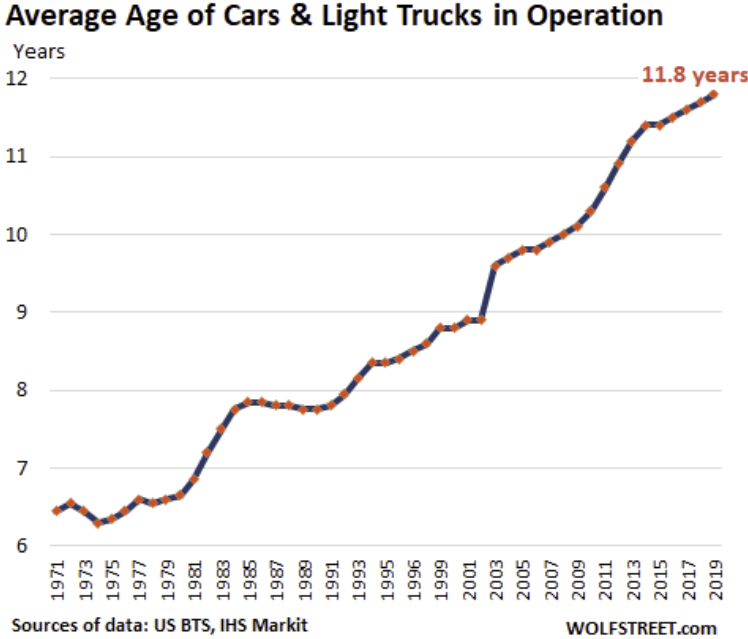
As for cars not lasting as long as they used to, statistics suggest otherwise:
Although it's hard to find a similar graph that extends from the 1970s all the way to 2024 or so. I suppose the trend could be headed for a fast reversal post-COVID, when cost-cutting became a religion.
Last edited by Larson E. Rapp; Feb 15, 2025 at 06:20 PM.
I can't help but wonder what the venn diagram looks like of people who cry about cars "not lasting like they used to" and people who balk at doing basic preventive time-interval maintenance like brake fluid, coolant, oil, and spark plugs...
I like that it’s still around and new people post. It helps identify who not to buy a car from.