When you click on links to various merchants on this site and make a purchase, this can result in this site earning a commission. Affiliate programs and affiliations include, but are not limited to, the eBay Partner Network.
So in my 987.1 2.7L - an odd thing happened the other day, when I started my car to go on my lunch break it welcomed me with a cloud of white smoke (the car had been sitting for about 4 hours). I thought this was odd as it's never happened before. And then the same thing happened to me again today. I've read a couple different things from unburnt fuel to the possibility of my AOS.
To give some background, my daily routine is the same, I drive in the morning (also, does NOT smoke at all on cold start after sitting all night) about 20 min to the coffee shop by my office, run in and take about 10-15 min to myself, and then drive the 5 min from the coffee shop to my office where the car sits for about 4 hours until I go to my lunch break, 15 min home to let the dog out, then back to the office, neither times noticing ANY smoke. The only real time I noticed it is at the same time each of the last two days. Didn't even smoke at the end of the day when I started it to commute back home.
The car has 84K mi - I've read that the car can produce this after short trips (possibly the couple min from coffee shop?) and its unburnt fuel and some symptoms dont really coincide with AOS ("smokescreen" while driving, soot on exhaust tips) and its only done it twice in as many days...
Sorry for the long post, but trying to be as detailed as possible
Looks pretty much the same as this clip (this is not my car)
I should have expanded a little so maybe you can fill in if you are seeking an opine:
I meant how long have you been doing this routine with the short stops?
I think and my car has done it only a couple of times.......smoke cloud on start up.....when I have run it while cold into the driveway and then stop. It is not uncommon.
A problem may arise when you do this for an long time. I have made a habit of getting in the car and getting it up to temp and revs up as soon as warm (175) deg.
I have about 88k on my CS 987.1, but I have a 3.4.
Here is what happens.....again as I understand it. The mixture is enriched at startup and given the clearance on the cylinder walls washes the oil off the cylinder walls temporarily. Upon shutoff this mixed oil and fuel sits on the cylinder walls and since it is a flat configuration just sits there instead of draining into the sump. Then when you start it, this it burnt causing the smoke on startup.
The fear is that done repeatably can enhance the "bore scoring" of the cylinder walls. The 2.7 are not as prone to this from what I have "heard" and read.
I religiously change my oil at 5k intervals and don't take my car for short runs to the grocery store.
I'd change up your habits and an oil change and see what happens. If you really want to rest easy have a borescope done.
If it has only happened twice with your car, I wouldn't worry about it frankly.
Also, maybe someone could correct me but Ive read that if there is suction when removing the oil fill cap that is also a sign that the Oil Air Separator is going bad as well.
Just did a little get myself, and there definitely is some suction. I can feel it when I place my hand over the opening without the cap, and it also pulls the cap into the opening almost like a little magnet.
I think I'm going to order a new AOS - but before I do open to hearing if anyone thinks it may be something else
So in my 987.1 2.7L - an odd thing happened the other day, when I started my car to go on my lunch break it welcomed me with a cloud of white smoke (the car had been sitting for about 4 hours). I thought this was odd as it's never happened before. And then the same thing happened to me again today. I've read a couple different things from unburnt fuel to the possibility of my AOS.
To give some background, my daily routine is the same, I drive in the morning (also, does NOT smoke at all on cold start after sitting all night) about 20 min to the coffee shop by my office, run in and take about 10-15 min to myself, and then drive the 5 min from the coffee shop to my office where the car sits for about 4 hours until I go to my lunch break, 15 min home to let the dog out, then back to the office, neither times noticing ANY smoke. The only real time I noticed it is at the same time each of the last two days. Didn't even smoke at the end of the day when I started it to commute back home.
The car has 84K mi - I've read that the car can produce this after short trips (possibly the couple min from coffee shop?) and its unburnt fuel and some symptoms dont really coincide with AOS ("smokescreen" while driving, soot on exhaust tips) and its only done it twice in as many days...
Sorry for the long post, but trying to be as detailed as possible
Looks pretty much the same as this clip (this is not my car)
84K miles is certainly in the AOS mileage failure window.
Are you sure the "smoke" is smoke and not water vapor? Water vapor dissipates even with no breeze while (oil) smoke hangs together even in a breeze. It was not unburnt fuel. These engines do not allow unburnt fuel to collect any where.
Is the oil level ok?
I believe the car is used and thus new to you and a bit of an unknown. If so how long has the oil been in service? Do you know if the "right" oil was used? (Any Porsche approved oil is ok although if you drive in cold climes ( -25C ) Porsche says to use 0w-40 oil.)
Based on my experience: With my 2002 Boxster I went through 3 AOSs; that an AOS has gone bad is when the engine is idling that while one can unscrew the oil tube filler cap he can't remove it or if he can it requires considerable effort. A healthy AOS generates or provides for a bit of low pressure in the crankcase but nothing that make it difficult to impossible to remove the oil filler tube cap.
However, even if the cap can be removed that is not sufficient to remove the AOS from the list of explanations for the smoking. My experience is the hard to impossible to remove oil filler tube cap is that is a sign of an AOS that has failed and is going further downhill. That the AOS has decided to go bad is bad enough but it can get to the point oil (in the form of oil vapor/droplets) can be sucked out of the engine and this can allow enough oil into the engine to result in hydraulic locking of the engine. This can ruin an engine.
Can't make a 100% confidence diagnosis the problem is a bad AOS but if the smoke is oil smoke and the engine is not overfilled with oil and the oil doesn't have excessive amount of miles on it and the oil is reasonably correct the AOS is still #1. Have to mention that far and away the AOS has been the problem. I can't recall a time when it was an engine overfilled with oil or oil past it change by date or by the wrong oil being used.
If the "smoke" is not smoke but water vapor unless you live where other cars are generating a bit of a water vapor cloud under similar operating conditions that can be some kind of coolant leak. If the smoke or whatever smells of anti-freeze that's not a good odor for exhaust to have.
The oil is Mobil1 0w-40 as recommended and only a couple thousand miles old, if that, as I did an oil change when I purchased the vehicle about a month ago.
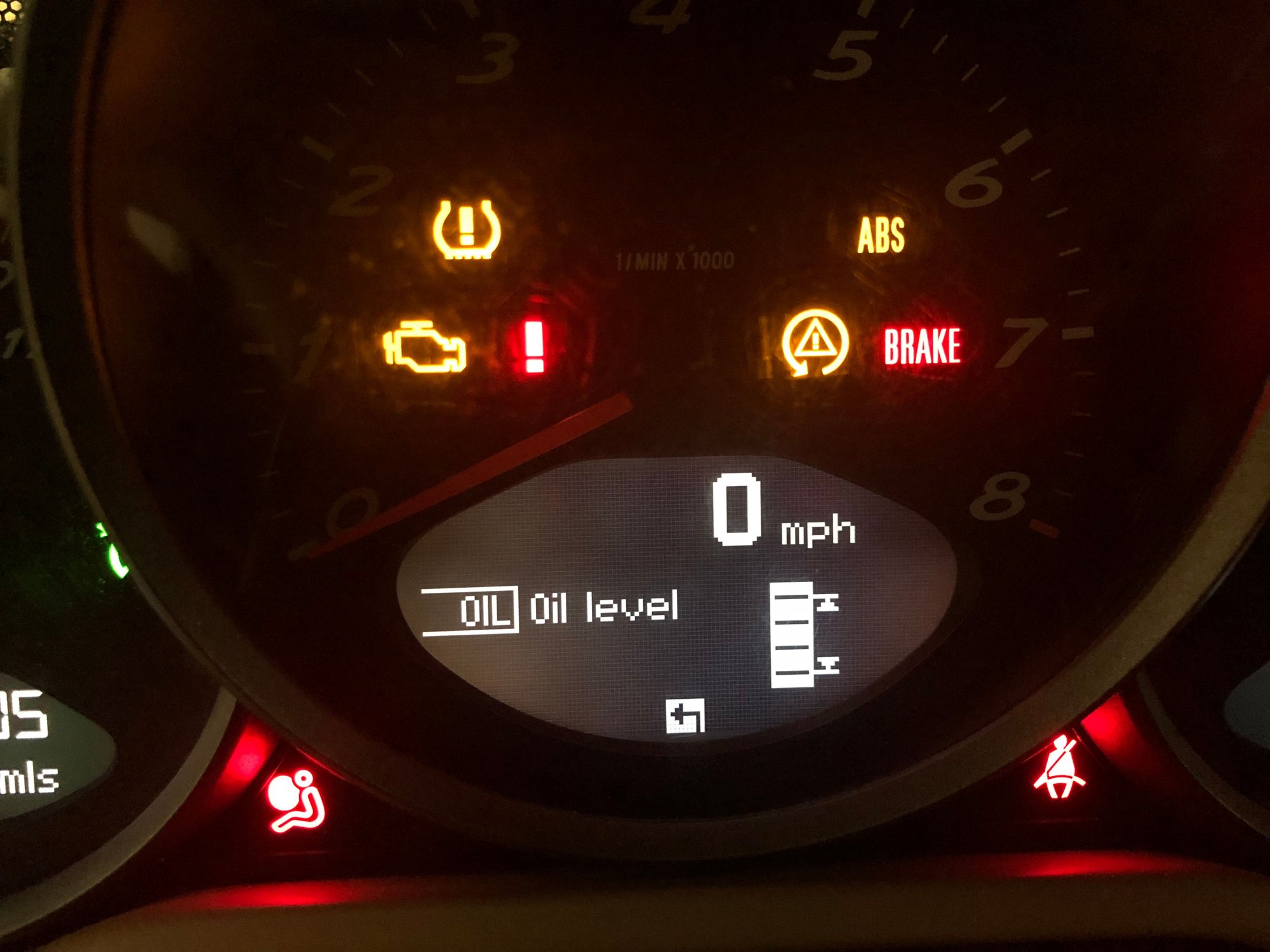
Oil level shows full when measured with the instrument cluster stalk.
Definitely isn't condensation, I can tell the difference between oil smoke and condensation.
Seems as though we both are leaning towards AOS. Any video Ive watched of those with bad AOS were able to remove the oil cap but did experience some "suction" effect. I will order a new one tomorrow and I suppose keep the driving to a minimum until I am able to replace it.
You have too much oil in there, you do not want to be at the top bar at all. Take out .5 a quart and recheck it. If you’re not driving hard you can leave it at the 1st bar from the top, if you drive hard I would drop to the second bar from the top.
Just a guess from the info provided, but I don't think it is the AOS. There is always suction from the oil filler - the issue is how much. Go to the Pelican site and read the article on what the suction should be. As I recall, if you're in the 5"-7" water range you're OK, but it will be much higher with a bad AOS (and lower with severe bore scoring). Given your driving habits it sure sounds like excess fuel being burned off. You should be able to smell the acrid odor of burned fuel - very different from burned oil or water vapor. I get that issue when I pull the car in and out of the garage without running it for a while to burn off the excess fuel. Excess oil may be the issue, so that would be the first thing to rectify.
Just a guess from the info provided, but I don't think it is the AOS. There is always suction from the oil filler - the issue is how much. Go to the Pelican site and read the article on what the suction should be. As I recall, if you're in the 5"-7" water range you're OK, but it will be much higher with a bad AOS (and lower with severe bore scoring). Given your driving habits it sure sounds like excess fuel being burned off. You should be able to smell the acrid odor of burned fuel - very different from burned oil or water vapor. I get that issue when I pull the car in and out of the garage without running it for a while to burn off the excess fuel. Excess oil may be the issue, so that would be the first thing to rectify.
I will look into the article and check back, thanks for the info. I haven't a clue what 5"-7" water range means, but hopefully will become more clear once I actually read the article. I'm hoping that its just excess fuel being burned but I've gotten a couple contradictory pieces of advice, both, from my research and the responses her.
EDIT: read the article, and although its written for Boxster I would imagine its the same with the Cayman. I dont know about running that vac test, but I will just pull the lines and see if theres any oil residue in there before ordering the part. Will check back in once I check the lines. May just order it to have in the mean time.
I measure crankcase vacuum annually just to keep tabs on things. Although I built a manometer with tubing and colored water (because I oddly enjoy doing stupid things like that), probably a better solution would be a cheap manometer like this one on amazon -
. I bought one recently to diagnose some HVAC issues, but it should work fine for crankcase vacuum. I guess you also need an oil filler cap with vac fitting - I built one of those from a spare cap and barbed fitting. The video series on bore scoring by LN Engineering also mentions measuring crankcase vacuum, but more from the standpoint of diagnosing a bore scoring issue.
You have too much oil in there, you do not want to be at the top bar at all. Take out .5 a quart and recheck it. If you’re not driving hard you can leave it at the 1st bar from the top, if you drive hard I would drop to the second bar from the top.
OT but can you explain the advantages/rationale behind dropping to 2nd from top bar if driving hard? I'm a new 987 owner and will be tracking/autoxing the car, so this sounds like something I should be doing (my current oil level is one bar from top).
OT but can you explain the advantages/rationale behind dropping to 2nd from top bar if driving hard? I'm a new 987 owner and will be tracking/autoxing the car, so this sounds like something I should be doing (my current oil level is one bar from top).
Oil foams and expands when the car is driven hard. Some oils foam less than others but they all experience it to some degree. When your car is reading the oil level it’s typically not when the oil is hot or foamed due to a hard drive, It’s at idle. When you’re on the track or cornering hard the oil is sloshing around and as it generates foam this ends up exhausting back into your AOS and whatever gets passed the AOS goes into your intake. On older cars it wasn’t an issue but with DI cars the gas doesn’t clean the intake and you get the eventual buildup.


 AOS going bad?