


H5 headlight Improved Halogen Bulb zXe

Racer
Joined: Apr 2009
Posts: 329
Likes: 1
From: Dubai, UAE

Oh crap, I just realised that I converted to H4's as well! Dammit! Another pair of 9004 zXe's for sale in Dubai! lol

Racer

Joined: Aug 2009
Posts: 399
Likes: 15
From: Houston, TX
Thanks to all for the input! I replaced my H5's with an HID kit from ebay a few years back, but I'm wanting to go back to stock once I get around to removing the HID kit. H4's aren't in the budget, so I'll probably experiment with the SilverStar options...

Racer
Joined: Aug 2013
Posts: 432
Likes: 1
From: Columbus, OH
Carl- I don't really notice a blue tint in the bulbs, definitely a much more white light than the typical halogens.
Reference? I work in optics, of sorts, though completely unrelated to human perception. My eyeballs have always told me that bluer light illumination offers more contrast discrimination than red light illumination in my experience. And I believe that color discrimination is at its best with broad white light illumination. CRI should decline if the color temperature moves toward red or blue.
Anyway, manufacturers seem to not give actual output in lumens for their products, so who knows what these bulbs actually put out. There is a range within the DOT rules. Given the lower lifetime of the bulbs, they're obviously not just regular bulbs with a blue tint. All that I can say for sure is that they appear brighter to my eyes and the color is closer to white, neither yellow nor blue. It's a cheap an easy upgrade in my opinion.
Reference? I work in optics, of sorts, though completely unrelated to human perception. My eyeballs have always told me that bluer light illumination offers more contrast discrimination than red light illumination in my experience. And I believe that color discrimination is at its best with broad white light illumination. CRI should decline if the color temperature moves toward red or blue.
Anyway, manufacturers seem to not give actual output in lumens for their products, so who knows what these bulbs actually put out. There is a range within the DOT rules. Given the lower lifetime of the bulbs, they're obviously not just regular bulbs with a blue tint. All that I can say for sure is that they appear brighter to my eyes and the color is closer to white, neither yellow nor blue. It's a cheap an easy upgrade in my opinion.
You're not too far off from the concept of color discrimination, as that plays a large part of a light source at night.
http://www.danielsternlighting.com/t...dvantages.html

Drifting

Joined: Nov 2004
Posts: 2,265
Likes: 180
From: Texas/France

Burning Brakes
Joined: Dec 2002
Posts: 1,057
Likes: 11
From: Vancouver B C
I purchased a spare set of H-4 lenses from Germany.
I am in Canada, so the shipping cost was the same as if purchasing from Pelican(less, actually) I am a bit surprised that Pelican even has them available.
I paid quite a bit less, however that was a year ago.
I am in Canada, so the shipping cost was the same as if purchasing from Pelican(less, actually) I am a bit surprised that Pelican even has them available.
I paid quite a bit less, however that was a year ago.
Pro
Joined: Oct 2012
Posts: 536
Likes: 2
From: Brockville, On, Canada
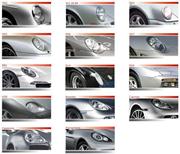
Wondering if someone would be willing to make a PayPal purchase for $50 eBay headlamps for me? It is not allowing me to purchase with my Canadian PayPal account. I have a US shipping address so the shipping is free and I can transfer via PayPal
Rennlist Stories
The Best Porsche Posts for Porsche Enthusiasts

Every Era of 911 Owner Explained in One Sentence
Verdad Gallardo
Thinking of Buying a Porsche? Do These 10 Things First
Joe Kucinski
Pixar Pals Turned Into 1-of-1 Porsches!
Michael S. Palmer
Theon Goes Full Carbon Fiber With Stunning New Build
Verdad Gallardo
Genius Porsche-Themed Gifts That'll Make Any Dad or Grad Smile
Joe Kucinski
10 Used Porsches Are Selling for Way Too Cheap
Joe Kucinski
Tuner Is Converting Porsche 911s Into Shooting Brakes
Verdad Gallardo
This Coachbuilt Creation Is A Modern Take on the Legendary Porsche 917
Verdad Gallardo
Is This Convertible Cayenne A Steal, Or A Returnless Investment?
Verdad Gallardo
Three Wheelin'
Joined: Feb 2003
Posts: 1,782
Likes: 110
From: Cambridge/Boston, MA
It's new year's eve, since this is kind of related to what I do in the office, I'll justify this departure into photometric physics. Plus, I find human vision interesting anyway. 
I've come across the Daniel Stern site before. It is comprehensive. However, maybe I'm used to describing light in a different way, but his explanations come across as very qualitative and not easy to follow. The complete lack of references doesn't help (makes me want to stab the author...).
Two questions in this whiter/bluer light bulb business.
1. Do these bulbs put out less total light?
2. Is whiter light any better for our vision?
A standard, stock, halogen has a color temperature of 3200K (also known as a 3200K black body emitter). These fancy Sylvania bulbs peak at 4200K. To be DOT legal, the bulb has to adhere to the total visible light output guideline (700/1200 lumens for our low/high beam 9004/HB1/H5 bulbs). There is some allowed variance in the DOT guideline that allows for slightly brighter and dimmer bulbs, but it isn't by a whole lot. I did find that bulbs rated specifically as "long-life" are rated as a slightly lower output. That answers the total light question. Just make sure the bulbs are DOT legal.
What I thought was really interesting is the question of whether a whiter illumination (higher color temperature) allows people to see any better at night. So I'm thinking, what is the human eye's sensitivity at night as a function of wavelength? Mesopic vision is what we use for medium illumination environments like headlight lit roadways. Mesopic vision uses our eyeball's brightness-sensitive rods and our color-sensitive cones. I found a plot of sensitivity v. wavelength at mesopic illumination levels from the Rensselaer lighting research center-

http://www.lrc.rpi.edu/programs/Futu...to/roadway.asp
First of all, neat! Second, what does it mean? Simple interpretation is that I would suspect that ideal illumination would come from a light source that produces a spectrum with the exact shape as the mesopic plot above. In reality, human vision seems to have all kinds of weird exceptions, so who knows. In terms of halogen bulbs, pushing the color temperature peak closer to the mesopic peak, while maintaining total light output, should give better nighttime illumination according to this plot. That peak is at about 5700K (Wien's law) in the plot.
Making a halogen with a filter that simulates a 5700K color temp, but still puts out the same total amount of visible light, would probably produce a bulb that lasts about an hour. So ~4200K is what the manufacture thinks is a good lifetime vs. color temp tradeoff. Pushing closer to the blue end of the spectrum has the disadvantage of worse visibility in fog/rain/etc., so there is a tradeoff there too.
HID lights are *completely* different. They're not a black body emitter, they're an emission line emitter. Good old quantum mechanical electron energy level jumps in the materials, loads of fun. HID's provide much worse color discrimination because they illuminate with only a few narrow-band wavelengths of light. Contrast that to the broad-spectrum illumination of a black body halogen. HID lights do emit a lot closer to that 5700K color temperature where our eyes are the most sensitive. If it were me, I would run an emission line filter to remove the HID intensity spikes, turn up the total output, and you get a pretty decent band pass of visible light. Easier said than done. But currently, the human eye's color discrimination with HID lights is kind of crappy.
This is handy, a quick reference on halogen and HID spectra.
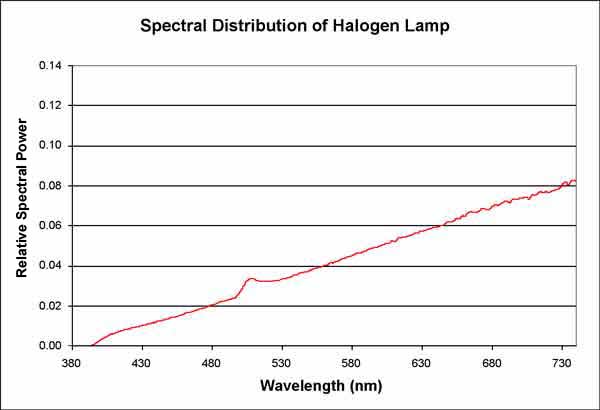
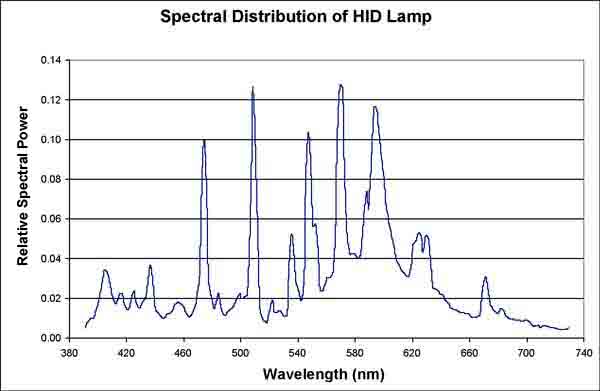
http://www.fhwa.dot.gov/publications.../character.cfm
Okay, hanging up my physicist hat in time to prep for tonight. Happy New Year!
I've come across the Daniel Stern site before. It is comprehensive. However, maybe I'm used to describing light in a different way, but his explanations come across as very qualitative and not easy to follow. The complete lack of references doesn't help (makes me want to stab the author...).
Two questions in this whiter/bluer light bulb business.
1. Do these bulbs put out less total light?
2. Is whiter light any better for our vision?
A standard, stock, halogen has a color temperature of 3200K (also known as a 3200K black body emitter). These fancy Sylvania bulbs peak at 4200K. To be DOT legal, the bulb has to adhere to the total visible light output guideline (700/1200 lumens for our low/high beam 9004/HB1/H5 bulbs). There is some allowed variance in the DOT guideline that allows for slightly brighter and dimmer bulbs, but it isn't by a whole lot. I did find that bulbs rated specifically as "long-life" are rated as a slightly lower output. That answers the total light question. Just make sure the bulbs are DOT legal.
What I thought was really interesting is the question of whether a whiter illumination (higher color temperature) allows people to see any better at night. So I'm thinking, what is the human eye's sensitivity at night as a function of wavelength? Mesopic vision is what we use for medium illumination environments like headlight lit roadways. Mesopic vision uses our eyeball's brightness-sensitive rods and our color-sensitive cones. I found a plot of sensitivity v. wavelength at mesopic illumination levels from the Rensselaer lighting research center-
http://www.lrc.rpi.edu/programs/Futu...to/roadway.asp
First of all, neat! Second, what does it mean? Simple interpretation is that I would suspect that ideal illumination would come from a light source that produces a spectrum with the exact shape as the mesopic plot above. In reality, human vision seems to have all kinds of weird exceptions, so who knows. In terms of halogen bulbs, pushing the color temperature peak closer to the mesopic peak, while maintaining total light output, should give better nighttime illumination according to this plot. That peak is at about 5700K (Wien's law) in the plot.
Making a halogen with a filter that simulates a 5700K color temp, but still puts out the same total amount of visible light, would probably produce a bulb that lasts about an hour. So ~4200K is what the manufacture thinks is a good lifetime vs. color temp tradeoff. Pushing closer to the blue end of the spectrum has the disadvantage of worse visibility in fog/rain/etc., so there is a tradeoff there too.
HID lights are *completely* different. They're not a black body emitter, they're an emission line emitter. Good old quantum mechanical electron energy level jumps in the materials, loads of fun. HID's provide much worse color discrimination because they illuminate with only a few narrow-band wavelengths of light. Contrast that to the broad-spectrum illumination of a black body halogen. HID lights do emit a lot closer to that 5700K color temperature where our eyes are the most sensitive. If it were me, I would run an emission line filter to remove the HID intensity spikes, turn up the total output, and you get a pretty decent band pass of visible light. Easier said than done. But currently, the human eye's color discrimination with HID lights is kind of crappy.
This is handy, a quick reference on halogen and HID spectra.
http://www.fhwa.dot.gov/publications.../character.cfm
Okay, hanging up my physicist hat in time to prep for tonight. Happy New Year!
Instructor
Joined: May 2009
Posts: 173
Likes: 7
From: Carrollton, GA
Gus, I'm in
...and can save you postage. My car is at Goldcrest now. Amazing cars they are working on.
http://www.goldcrestmotorsports.com/
Larry
http://www.goldcrestmotorsports.com/
Larry
Three Wheelin'
Joined: Feb 2003
Posts: 1,782
Likes: 110
From: Cambridge/Boston, MA
^ Yep, H3 for the fogs. I always keep the fogs on with the headlights. They light up the area directly in front of the nose of the car and outward on each side. Perfect for lighting up the painted lines on the road that can be invisible on dark rainy nights. The extra light can make you more noticeable too. Plus they turn off when you flash your brights- more obvious if you're trying to wake up somebody asleep in the passing lane on the highway.
Related- I picked up some 796 bulbs (35W @ 12.8V) for the reverse lights to replace the stock 7506/1196 bulbs (27W @ 12.8V). These should be noticeably brighter without overloading the housing. Will be nice to see behind me while backing out of the driveway.
Related- I picked up some 796 bulbs (35W @ 12.8V) for the reverse lights to replace the stock 7506/1196 bulbs (27W @ 12.8V). These should be noticeably brighter without overloading the housing. Will be nice to see behind me while backing out of the driveway.