



Cup car suspension....

Burning Brakes
Joined: May 2001
Posts: 1,199
Likes: 1
From: www.cupcar.net

It's got a cop motor, a four hundred and forty cubic inch plant, it's
got cop tires, cop suspension, cop shocks, it was a model made before
catalytic converters so it'll run good on regular gas. Whaddya say?
got cop tires, cop suspension, cop shocks, it was a model made before
catalytic converters so it'll run good on regular gas. Whaddya say?
Rennlist Member

Joined: Nov 2001
Posts: 4,152
Likes: 356
From: Keswick, VA
Your mechanic should be able to order it directly from H&R. That's what was done when my dad had the H&R Super Cup Suspension installed in his 93 C2.
You will hate it on the street, but man will you LOVE it on the track!
You will hate it on the street, but man will you LOVE it on the track!
Burning Brakes
Joined: May 2001
Posts: 1,199
Likes: 1
From: www.cupcar.net
Sorry, I misread, you said "Cup".
1. Cup shocks, they are Bilstein with Cup valving. Green. Fully threaded for ride height adjustment.
2. Cup springs and hats. They are Eibach progressive. You can't buy them anymore. Rates are about 600/800.
3. Cup monoballs, front and rear. Factory Cup monoballs are not camber adjustable.
4. Cup brakes, like '92 turbo with special Cup rear calipers.
5. Cup hubs and uprights, like turbo.
6. Cup A-arms and trailing arms with stiffer rubber bushing.
7. Cup anti-roll bars. Adjustable 5 way front and 3 way rear.
8. Cup front camber brace.
9. Cup rear camber eccentrics and reversed "spring plates" to allow more rear negative camber.
What am I missing?
PS: The above assumes you are looking to duplicate the Cup suspension using factory original parts, some of which may be no longer available new. You can certainly build a "Cup-like" suspension using aftermarket parts which is equivalent or better than the factory approach.
1. Cup shocks, they are Bilstein with Cup valving. Green. Fully threaded for ride height adjustment.
2. Cup springs and hats. They are Eibach progressive. You can't buy them anymore. Rates are about 600/800.
3. Cup monoballs, front and rear. Factory Cup monoballs are not camber adjustable.
4. Cup brakes, like '92 turbo with special Cup rear calipers.
5. Cup hubs and uprights, like turbo.
6. Cup A-arms and trailing arms with stiffer rubber bushing.
7. Cup anti-roll bars. Adjustable 5 way front and 3 way rear.
8. Cup front camber brace.
9. Cup rear camber eccentrics and reversed "spring plates" to allow more rear negative camber.
What am I missing?
PS: The above assumes you are looking to duplicate the Cup suspension using factory original parts, some of which may be no longer available new. You can certainly build a "Cup-like" suspension using aftermarket parts which is equivalent or better than the factory approach.
Trending Topics
Technical Specialist
Rennlist
Lifetime Member
Rennlist
Lifetime Member
Joined: May 2001
Posts: 5,865
Likes: 26
From: TX
Note, a cup car suspension is more than the shock/spring/monoball mount kits. JC did a good job of outlining the components. You might also look at Paul Frere's '911 Story' too. There might be some good parts from the RSR 3.8 too.
Rennlist Stories
The Best Porsche Posts for Porsche Enthusiasts
9 Features and Characteristics That Only Porsche People Understand
Verdad Gallardo
I've Written 500 Rennlist Articles: Here's How Porsche Has Changed Along the Way
Joe Kucinski
10 Most Unnecessary Porsches Ever Built (And Why We Love Them)
Verdad Gallardo
Porsche 911 GT3 S/C vs 718 Spyder RS: 10 Categories, One Winner
Joe Kucinski
This Builder Is Turning Heads With Its Slantnose 911 Creation
Verdad Gallardo
Porsche 911 GT3 Artisan Edition Pays Homage to Japanese Culture
Verdad Gallardo
Porsche Reveals Coupe Variant of the Electric Cayenne With a Fresh Look
Verdad Gallardo
10 Porsche Colors That Have More Personality Than Most People
Verdad Gallardo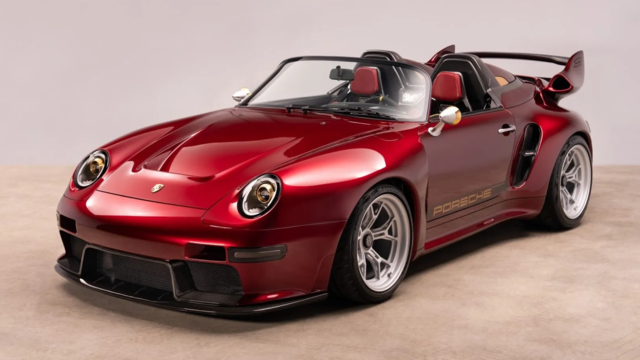
Guntherwerks' Final Speedster Creation Is the Ultimate Porsche Restomod
Verdad Gallardo
Technical Specialist
Rennlist
Lifetime Member
Rennlist
Lifetime Member
Joined: May 2001
Posts: 5,865
Likes: 26
From: TX
</font><blockquote><font size="1" face="Verdana,Tahoma,Helvetica">quote:</font><hr /><font size="2" face="Verdana,Tahoma,Helvetica"><strong>The exact spring rates are 200-600 lbs/inch front and 240-800 ibs/inch rear.</strong></font><hr /></blockquote><font size="2" face="Verdana,Tahoma,Helvetica">Since Porsche doesn't usually publish spring rates, curious what the source is? Good information, btw.
Burning Brakes
Joined: May 2001
Posts: 1,199
Likes: 1
From: www.cupcar.net
Bill,
The data comes from Joel Rieser who is the PCA tech guy for 911's and Cup cars. He had a set of original factory racing Carrera Cup springs from a Euro 964 Cup and I asked him to measure them on his spring tester.
The data comes from Joel Rieser who is the PCA tech guy for 911's and Cup cars. He had a set of original factory racing Carrera Cup springs from a Euro 964 Cup and I asked him to measure them on his spring tester.
Rennlist Member
Joined: Jun 2001
Posts: 3,886
Likes: 167
From: California Boardwalk, Skanderborg Denmark
I installed the H&R Supercup kit. It has several nice features:
1) Bilstein manufacture shocks (valved by H&R)
2) It uses the racing Bilstein front strut with the large diameter piston rod which is much more ridgid than the smaller diameter rod of the street part.
3) Bilstein Aluminum rear shocks which are very light in weight and also have a spherical bearing lower mount.
4) Spherical bearing upper mounts front and rear
5) Tandem springs with 457 pound per inch front main springs and 140 pound per inch helper springs. The rear rates are 685 main and 226 helper. These rates and the shock settings seem nicely chosen as the car works well at autocross.
6) Adjustable strut mount so you can change the front camber at the top of the strut.
7) Beautiful construction
The H&R kit has a few problems I ran into during my installation however:
1) The rear upper bearing would not fit in the shock tower and had to be machined by me to fit. H&R said this was not possible that it had to fit, offering no real help.
2) The design of the adjustable strut mount in front is not water proof and there is a direct shot for water to come off the top of the tire and into the trunk. I thought a seal or something was missing but H&R told me this was a racing part and I had to expect to make concessions to performance.
3) I could not get any more negative camber in front with the H&R mount than with the stock Porsche RS monobal mounts I had before, so the new mounts were useless to me. I redesigned the mount and made another trip to the machinist.
One note on the spring rates supplied by JC in NY. The Cup springs are one piece units and in order to use a one piece spring with high working rates, the spring has to be progressive if it is not to dangle on full extension of the shock. This is because if the spring rate is to be greater than the rate equal to the static load on the spring divided by the inches of spring travel required to collapse it from full extended to ride height, a progressive spring is required or the spring has to be made short and dangle free on full extension.
For example, in the rear if the spring were linear at 800 pounds per inch then the spring load would have to be around 3200 pounds to collapse the spring the 4 inches or so necessary to get it down to ride height. This is way more than the 840 pounds my car has on each rear wheel could accomplish given the motion ratio of the rear suspension.
It would be interesting to know the working rates of the Cup springs from their length at ride height to full compression- I bet they are relatively linear.
The other solution is to go to a Tandem system like the H&R with spring rates and lengths chosen to allow the system to work. My helper springs are fully compressed at ride height BTW.
Another note on spring rates, Porsche gave the rates of the 993 RS springs in their 993 RS literature. They are 245 front and 456 rear, furthermore the part number on the 993 RS front spring is the same as the 964 RS's so 245 is the rate of the 964 RS front spring, I bet the 964 RS rears are similar in rate to the 993 RS's <img border="0" alt="[typing]" title="" src="graemlins/yltype.gif" />
1) Bilstein manufacture shocks (valved by H&R)
2) It uses the racing Bilstein front strut with the large diameter piston rod which is much more ridgid than the smaller diameter rod of the street part.
3) Bilstein Aluminum rear shocks which are very light in weight and also have a spherical bearing lower mount.
4) Spherical bearing upper mounts front and rear
5) Tandem springs with 457 pound per inch front main springs and 140 pound per inch helper springs. The rear rates are 685 main and 226 helper. These rates and the shock settings seem nicely chosen as the car works well at autocross.
6) Adjustable strut mount so you can change the front camber at the top of the strut.
7) Beautiful construction
The H&R kit has a few problems I ran into during my installation however:
1) The rear upper bearing would not fit in the shock tower and had to be machined by me to fit. H&R said this was not possible that it had to fit, offering no real help.
2) The design of the adjustable strut mount in front is not water proof and there is a direct shot for water to come off the top of the tire and into the trunk. I thought a seal or something was missing but H&R told me this was a racing part and I had to expect to make concessions to performance.
3) I could not get any more negative camber in front with the H&R mount than with the stock Porsche RS monobal mounts I had before, so the new mounts were useless to me. I redesigned the mount and made another trip to the machinist.
One note on the spring rates supplied by JC in NY. The Cup springs are one piece units and in order to use a one piece spring with high working rates, the spring has to be progressive if it is not to dangle on full extension of the shock. This is because if the spring rate is to be greater than the rate equal to the static load on the spring divided by the inches of spring travel required to collapse it from full extended to ride height, a progressive spring is required or the spring has to be made short and dangle free on full extension.
For example, in the rear if the spring were linear at 800 pounds per inch then the spring load would have to be around 3200 pounds to collapse the spring the 4 inches or so necessary to get it down to ride height. This is way more than the 840 pounds my car has on each rear wheel could accomplish given the motion ratio of the rear suspension.
It would be interesting to know the working rates of the Cup springs from their length at ride height to full compression- I bet they are relatively linear.
The other solution is to go to a Tandem system like the H&R with spring rates and lengths chosen to allow the system to work. My helper springs are fully compressed at ride height BTW.
Another note on spring rates, Porsche gave the rates of the 993 RS springs in their 993 RS literature. They are 245 front and 456 rear, furthermore the part number on the 993 RS front spring is the same as the 964 RS's so 245 is the rate of the 964 RS front spring, I bet the 964 RS rears are similar in rate to the 993 RS's <img border="0" alt="[typing]" title="" src="graemlins/yltype.gif" />
