



16V adjustable cam timer *installed*

Thread Starter
Inventor
Rennlist Member
Rennlist Member

Joined: Sep 2002
Posts: 10,219
Likes: 469

Weissach1982 - 3/16"x2"x6" flat steel. This roller is an 85-86 idler roller (928 105 571 02), but I'm going to move to a 78-84 idler roller (928 105 571 00).
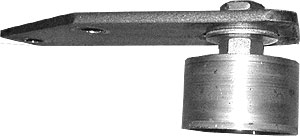
I tried fitting the large tensioner pulley. It fits, barely. It would be tough to get the cover over it. It puts a different angle on the belt, and more torque would be applied to the bearing.
What's worse, higher torque, or higher speed?
I tried fitting the large tensioner pulley. It fits, barely. It would be tough to get the cover over it. It puts a different angle on the belt, and more torque would be applied to the bearing.
What's worse, higher torque, or higher speed?

Addict
Rennlist Member
Rennlist
Site Sponsor
Rennlist Member
Rennlist
Site Sponsor
Joined: Jul 2001
Posts: 11,542
Likes: 4
From: Anaheim California
I would have some question about using an idler pulley or "tensioner pulley" on the tight high load portion of the timing belt . The normal position of those rollers is on the no load loose portion of the belt . The part which is unloaded just passing through . All the work is being done by the belt being pulled down the front of the engine by the crank gear (one reason the drivers side camshafts break most often ) The timing belt as it goes from the crank gear up to the passenger side cam DOES NO WORK so loads are light . The tensioner cup shaped washers can be damaged by turning the engine backwards with a wrench on the crank ...why ? they re not designed to handle all the load of turning the camshafts compressing valve springs . My point is those rollers may or may not be adequate for the higher loads ....I do not know . The tension tools measure the loose portion of the belt it can be much higher in other parts of the belt .
Thread Starter
Inventor
Rennlist Member
Rennlist Member
Joined: Sep 2002
Posts: 10,219
Likes: 469
Jim bailey - thanks for the info.
I did not know that the tensioner's bi-metal washers were the reason for the warnings not to turn the crank CCW. Fortunately, I released all the tension (to create slack) before moving the crank.
The bearing in the idler pulley is of good size, however, I will be checking it's condition frequently.
The outside diameter of the idler pulley is 45mm, the belt is 1" wide. I would like to find a slightly larger pulley/bearing, 50-55mm from another application.
I did not know that the tensioner's bi-metal washers were the reason for the warnings not to turn the crank CCW. Fortunately, I released all the tension (to create slack) before moving the crank.
The bearing in the idler pulley is of good size, however, I will be checking it's condition frequently.
The outside diameter of the idler pulley is 45mm, the belt is 1" wide. I would like to find a slightly larger pulley/bearing, 50-55mm from another application.
Addict
Lifetime Rennlist
Member
Lifetime Rennlist
Member

Joined: May 2001
Posts: 12,272
Likes: 261
From: Hotlanta - NE of the Perimeter
Not to dampen the spirits of advance thinking, but I too, have reservations about adding an additional roller in the TB circuit. As mentioned, if the bracket were to fail, it may be possible that the TB may slacken enough to jump a tooth!!!
Another thought too - a recent post regarding the TB failure listed the root cause as a frozen tensioner just like this one. IF that were to occur, I'm certain that the same results will manifest themself upon the motor - ouch!
Now, back to your regularily scheduled programing.

Another thought too - a recent post regarding the TB failure listed the root cause as a frozen tensioner just like this one. IF that were to occur, I'm certain that the same results will manifest themself upon the motor - ouch!
Now, back to your regularily scheduled programing.

Drifting
Joined: Jul 2002
Posts: 3,348
Likes: 0
From: Los Angeles, CA
The title of this post is *16 valve* adjustable cam timer...
Not 32 valve.
Not all, but *most* 16v engines are non-interference, so there
is no issue with playing around with something like this...
It seems like a pretty simple way to make some gains...
I'd really like to see a before/after dyno, to show torque curves, etc...
Not 32 valve.
Not all, but *most* 16v engines are non-interference, so there
is no issue with playing around with something like this...
It seems like a pretty simple way to make some gains...
I'd really like to see a before/after dyno, to show torque curves, etc...
Thread Starter
Inventor
Rennlist Member
Rennlist Member
Joined: Sep 2002
Posts: 10,219
Likes: 469
bcdavis - You tell 'em!
We don't need those 32V 'fraidy cats telling us what's what.
I've decided to use one large wide bearing for the roller to handle the torque and be less of a worry.
~52mm outside diameter by ~24mm wide high speed sealed bearing on a steel plate bracket replacing the rear power steering bracket.
...
I went on a drive in the country a few days ago. Besides being sweeter in the twisties, I noticed that it ran hotter. Which (unlike in Ernest's car) is a good thing. Before the installation of the PorKen Widget, it ran too cool while cruising, barely getting out of the white zone, this I now apply to my cams being slightly retarded from ideal.
So, adding just a degree or two, to syncronize the cams/compensate for tolerances, can restore that new car perk!
We don't need those 32V 'fraidy cats telling us what's what.
I've decided to use one large wide bearing for the roller to handle the torque and be less of a worry.
~52mm outside diameter by ~24mm wide high speed sealed bearing on a steel plate bracket replacing the rear power steering bracket.
...
I went on a drive in the country a few days ago. Besides being sweeter in the twisties, I noticed that it ran hotter. Which (unlike in Ernest's car) is a good thing. Before the installation of the PorKen Widget, it ran too cool while cruising, barely getting out of the white zone, this I now apply to my cams being slightly retarded from ideal.
So, adding just a degree or two, to syncronize the cams/compensate for tolerances, can restore that new car perk!
Last edited by PorKen; Oct 30, 2003 at 01:40 PM.

Three Wheelin'
Joined: Apr 2003
Posts: 1,254
Likes: 1
From: Mendocino
PorKen, I was wondering about the same thing Jim said. And then he said it. I too would just advise that on that side of the cam sprocket, the belt is seeing valve spring forces. And not only that, but they are intermittent loading. That is, there's a frequency of loading. I think it's cool that it's working, but the question is how long before it has problems. The bellview washers in the tensioner are altogether another isssue. If I were doing this, I'd use bolts with safety wire, and some kind of locking for the idler nut also. It might be smart to turn the engine thru it's cycles with a dial indicator on the idler, to see if and how much it flexes. Other than that, have fun. I still think it's totally cool that it makes this much of a difference. Yeehaw.
Thread Starter
Inventor
Rennlist Member
Rennlist Member
Joined: Sep 2002
Posts: 10,219
Likes: 469
Gregg K,
I'm reaching my limit on 'real' engineering. (I'm a software guy.) Shopping for bearings for example has made my head hurt.
I (think I) need a sealed both sides, maximum 55mm OD, mininum 21mm wide bearing, that can handle the stresses you describe and a 10000RPM* minimum rating. And calculating the load requirement? Fuhgehdahbaodit.
*The cam gear diameter is 70mm. So a 50mm roller has a factor of 1.4 x 6200 max rpm = 8680?
I'm reaching my limit on 'real' engineering. (I'm a software guy.) Shopping for bearings for example has made my head hurt.
I (think I) need a sealed both sides, maximum 55mm OD, mininum 21mm wide bearing, that can handle the stresses you describe and a 10000RPM* minimum rating. And calculating the load requirement? Fuhgehdahbaodit.
*The cam gear diameter is 70mm. So a 50mm roller has a factor of 1.4 x 6200 max rpm = 8680?
Rennlist Stories
The Best Porsche Posts for Porsche Enthusiasts

Stunning Porsche 356A Super GT Speedster Auction Fails to Meet Reserve
Verdad Gallardo
Every Era of 911 Owner Explained in One Sentence
Verdad Gallardo
Thinking of Buying a Porsche? Do These 10 Things First
Joe Kucinski
Pixar Pals Turned Into 1-of-1 Porsches!
Michael S. Palmer
Theon Goes Full Carbon Fiber With Stunning New Build
Verdad Gallardo
Genius Porsche-Themed Gifts That'll Make Any Dad or Grad Smile
Joe Kucinski
10 Used Porsches Are Selling for Way Too Cheap
Joe Kucinski
Tuner Is Converting Porsche 911s Into Shooting Brakes
Verdad Gallardo
This Coachbuilt Creation Is A Modern Take on the Legendary Porsche 917
Verdad Gallardo
Three Wheelin'
Joined: Apr 2003
Posts: 1,254
Likes: 1
From: Mendocino
The idler is only making a small deflection in the belt. It should be ok, that way. The idler may need a bracket on each side of the bearing. Maybe a billet part. Yep, the only thing to be aware of is the bearing needing support on both sides. And vibration loosening things.
Thread Starter
Inventor
Rennlist Member
Rennlist Member
Joined: Sep 2002
Posts: 10,219
Likes: 469
Second prototype installed:
Heavy duty, 7/8" wide, double row, sealed both sides, 52mm bearing.
Gives approximately 1-5 degrees cam advance. I'm trying out 4-4.5 degrees presently.
Rear power steering bracket:
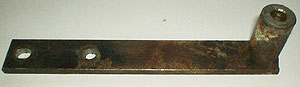
Replaced by:
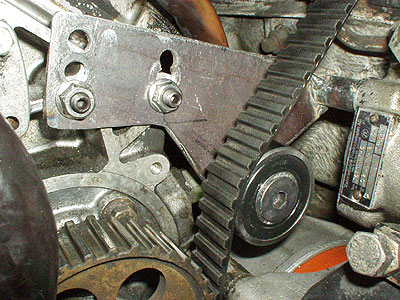
Another side benefit I noticed: more teeth of the belt over the oil pump gear, which ought to reduce the per tooth stress of driving the pump.
Gives approximately 1-5 degrees cam advance. I'm trying out 4-4.5 degrees presently.
Rear power steering bracket:
Replaced by:
Another side benefit I noticed: more teeth of the belt over the oil pump gear, which ought to reduce the per tooth stress of driving the pump.
Last edited by PorKen; Oct 29, 2003 at 01:50 PM.
Three Wheelin'
Joined: Apr 2003
Posts: 1,254
Likes: 1
From: Mendocino
Nice. It's part of the ps bracket. You know that's not going to be going anywhere. Forgive me, I'm not normally a nosey individual. But I find this whole thing really interesting. I suppose I've come off as a pita, but I'm just good at picking on problems. One thing I see (here I go again) is that this bearing appears to not be at least as wide as the belt. The stock roller is wider than the belt. I don't know that it's a problem, but it would be more confidence inspiring to see the roller supporting the entire width. Of course, that means a more expensive bearing. But then, double row might be overkill. Are you still happy with the performance? If so, it's a great mod.
Thread Starter
Inventor
Rennlist Member
Rennlist Member
Joined: Sep 2002
Posts: 10,219
Likes: 469
Gregg K - yer chappin' my hide! 
I haven't been able to find a 1" or wider bearing less than 62mm in diameter.
62mm would fit, but to change the PS belt, you might have to remove the advance pulley. It would require a larger hole cut in the covers too.
I could press a sleeve over the bearing, in fact, I could go with a smaller bearing with a sleave. But then what if the sleave migrates?
The stock idler pulley is looking again to be all I need.
...
At 4-4.5 degrees, it was running hotter, but I could bark the tires at every stoplight with just a medium push on the go plank! I've set it back down to 2-2.5 cam degrees. There's plenty enough there.
I haven't been able to find a 1" or wider bearing less than 62mm in diameter.
62mm would fit, but to change the PS belt, you might have to remove the advance pulley. It would require a larger hole cut in the covers too.
I could press a sleeve over the bearing, in fact, I could go with a smaller bearing with a sleave. But then what if the sleave migrates?
The stock idler pulley is looking again to be all I need.
...
At 4-4.5 degrees, it was running hotter, but I could bark the tires at every stoplight with just a medium push on the go plank! I've set it back down to 2-2.5 cam degrees. There's plenty enough there.
Last edited by PorKen; Oct 28, 2003 at 11:02 PM.
Three Wheelin'
Joined: Apr 2003
Posts: 1,254
Likes: 1
From: Mendocino
Hey, here's an idea. Use a Loctite locking compound on a sleeve. Call their tech line and see which one is intended for the purpose. Then you're safe, and don't need such a wide bearing. Plus the bearing can be smaller in diameter. Cheaper still.
