

Help w/ brake pad clacking on '88
Thread Starter
Three Wheelin'

Joined: Aug 2004
Posts: 1,673
Likes: 4
From: ann arbor, MI
 Help w/ brake pad clacking on '88
Well, I've chased down a clacking noise that comes from my driver's side front wheel to the brake pads/carriers. The noise was particularly obnoxious when starting forward after braking in reverse, so I'm pretty sure that my diagnosis is correct. The rears seem to clack occassionally, too.
Anyway, I've only got about 7k on the pads currently, so I don't think they'd be worn (or could they be?), but I also don't know the brand, as they were installed by the PO. I'm assuming that they're an ill-fitting aftermarket set.
Does anyone have any suggestions for replacements that won't make that clacking noise? I'm sure the Porsche stock pads are great, but are there any aftermarket brands I should consider?
I don't track the car, so I just need a solid performing set. I'm also running the stock slotted dish wheels, so I can deal with some additional brake dust in order to get a quiet set that won't squeal.
Thanks in advance for the tips, folks!
Anyway, I've only got about 7k on the pads currently, so I don't think they'd be worn (or could they be?), but I also don't know the brand, as they were installed by the PO. I'm assuming that they're an ill-fitting aftermarket set.
Does anyone have any suggestions for replacements that won't make that clacking noise? I'm sure the Porsche stock pads are great, but are there any aftermarket brands I should consider?
I don't track the car, so I just need a solid performing set. I'm also running the stock slotted dish wheels, so I can deal with some additional brake dust in order to get a quiet set that won't squeal.
Thanks in advance for the tips, folks!

Range Master
Pepsie Lite
Lifetime Rennlist
Member
Pepsie Lite
Lifetime Rennlist
Member
Joined: Apr 2002
Posts: 54,283
Likes: 1,236

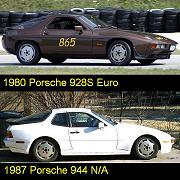
Can you tell if the PO installed the backing pads between the brake pads and the caliper pistons? If those are not there, I would expect the pads to make some noise. On the used pads in this picture, the upper set, they protrud on the back of the pad, and snap into the caliper pistons. Keeps the pads from moving around when not under braking conditions.
You sure it is brake pads? I have had a loose lug nut make a snapping noise at low speed before...............bearings tight?
You sure it is brake pads? I have had a loose lug nut make a snapping noise at low speed before...............bearings tight?
Last edited by Gretch; Jul 5, 2005 at 06:14 PM.
Still plays with cars.
Lifetime Rennlist
Member
Joined: Jul 2001
Posts: 15,077
Likes: 264
From: Montreal
Chaad, I don't remember any more but just in case... Do you calipers have a big flat spring on top which presses down on the pads? Some 928's with big brakes have them. If the spring getsd weak the pads clunk and clack. Bend the spring to add more pressure to the pads. If it is too old get new flat springs. This drove me nuts on a GT3 until a friend bent the spring more. Hope it is a simple as this!
Best,
Best,
Thread Starter
Three Wheelin'
Joined: Aug 2004
Posts: 1,673
Likes: 4
From: ann arbor, MI
Gretch-- I don't think I can tell if the backing pads are in place without removing the pads, which I didn't do. I lifted the car and grabbed and yanked on the wheels looking for bearing slop, but found none; that is the check process, right? Also, the noise is fairly predictable and can be induced repeatedly-- If I move forward a bit, brake, then but it in reverse, they'll clack, and also occassionally over the rough stuff, but not consistenly in that case. I'll check the lugs, though, just to rule that out.
Bob-- I didn't notice any such spring as you mention, but I wasn't looking, so I'll go out and check for them and try the bending trick. Thanks for the tip on that.
I gather that pad clacking is rather unusual then?
Bob-- I didn't notice any such spring as you mention, but I wasn't looking, so I'll go out and check for them and try the bending trick. Thanks for the tip on that.
I gather that pad clacking is rather unusual then?
Thread Starter
Three Wheelin'
Joined: Aug 2004
Posts: 1,673
Likes: 4
From: ann arbor, MI
Just a quick update...
I finally got around to pulling the wheels and checking out the calipers and pads. All of the pads wiggled easily when jostled by hand.
So, I pulled 'em all out, cleaned them up, and used an anti-squeal type goo (similar to Permatex, but red and from CarQuest) on the back, and reinstalled them. Gretch, you were right; no backing pads were evident. Oh, and Bob, I did have the springs on top of the calipers, but they seemed to have tension, so I didn't mess with those.
Took the car out for a spin, and they were silent! I'm happy for that, I tell ya!
Here's a question, should the Hawk Performance pads I have ought to have had the backing pads as they appear in Gretch's photo above, or is that a Porsche spec thing?
I finally got around to pulling the wheels and checking out the calipers and pads. All of the pads wiggled easily when jostled by hand.
So, I pulled 'em all out, cleaned them up, and used an anti-squeal type goo (similar to Permatex, but red and from CarQuest) on the back, and reinstalled them. Gretch, you were right; no backing pads were evident. Oh, and Bob, I did have the springs on top of the calipers, but they seemed to have tension, so I didn't mess with those.
Took the car out for a spin, and they were silent! I'm happy for that, I tell ya!
Here's a question, should the Hawk Performance pads I have ought to have had the backing pads as they appear in Gretch's photo above, or is that a Porsche spec thing?
Rennlist Member
Joined: Oct 2003
Posts: 7,210
Likes: 17
From: Nova Scotia
Chaad,
I replaced the worn ( and very dusty) oem Textars with Mintex pads - as my first opening of the '88 S4 calipers. I had expected to find the anti-squeel snap in type of pads Gretch pictured .... nada. Instead, the textars has a two or three layer stainless steel shim stack spot welded to the back side - presumably to serve the same function.
As the mintex pads arrived naked, the shims were good enough for me .... after carefully breaking the mini welds, slathered up with a good layer of anti-seize and stuffed in behind the new pads, they do their thing quietly.
I replaced the worn ( and very dusty) oem Textars with Mintex pads - as my first opening of the '88 S4 calipers. I had expected to find the anti-squeel snap in type of pads Gretch pictured .... nada. Instead, the textars has a two or three layer stainless steel shim stack spot welded to the back side - presumably to serve the same function.
As the mintex pads arrived naked, the shims were good enough for me .... after carefully breaking the mini welds, slathered up with a good layer of anti-seize and stuffed in behind the new pads, they do their thing quietly.
Nordschleife Master
Joined: Jul 2003
Posts: 7,743
Likes: 78
From: Minneapolis
The pads don't fit snugly as during braking the pads can get really hot and expand before the calipers do. This can lead to the "clack" sound when reversing direction after a stop.
Some pads have the extra plates, some don't. Often get tossed during brake work. Initially they're glued or tack welded on but break loose over time. I recall tht Hawk HP+ had them.
Some pads have the extra plates, some don't. Often get tossed during brake work. Initially they're glued or tack welded on but break loose over time. I recall tht Hawk HP+ had them.
Trending Topics
Thread Starter
Three Wheelin'
Joined: Aug 2004
Posts: 1,673
Likes: 4
From: ann arbor, MI
Thanks for the replies, guys. I guess I'll just roll with the goo fix for now, and if and when that fails, I'll go looking for some shims. I read an old post from Big Dave saying that he had used the goo and only got a few weeks of silent running, so I might be messing with the pads again pretty soon! I hope that goo doesn't leave behind a big mess in there....
Rennlist Stories
The Best Porsche Posts for Porsche Enthusiasts
Porsche's Top 5 Most Questionable Naming Decisions
Verdad Gallardo
Pogea Racing's 964 Porsche 911 Reimagination Stands Out in a Crowded Field
Verdad Gallardo
6 Convertible Top MYTHS Most People Don't Understand!
Michael S. Palmer
2026 Porsche 911 Club Coupe is Spectacular, And Everything Wrong with the Porsche Market
Joe Kucinski
Talos Takes Your 991 Porsche 911 GT3 to the Next Level for a Cool $1.13 Million
Verdad Gallardo
9 Vehicles Porsche Helped Engineer that Aren't Porsches
Verdad Gallardo
9 Features and Characteristics That Only Porsche People Understand
Verdad Gallardo
I've Written 500 Rennlist Articles: Here's How Porsche Has Changed Along the Way
Joe Kucinski