
Water pump idler pulley: function?


Thread Starter
Inventor
Rennlist Member
Rennlist Member

Joined: Sep 2002
Posts: 10,218
Likes: 468
 Water pump idler pulley: function?
What is the water pump idler pulley really for?
I have a plan for an automatic timing belt tensioner and the idler pulley can stay or go, but I'm wondering if it is necessary.
My plan is as follows:
*Remove tensioner assembly and tensioner arm.
*Mount aluminum plate onto tensioner bolts to hold new assembly and new (welded steel bar) air pump bracket.
*Mount original tensioner pulley on fixed plate, with limited adjustment for initial (loose) tensioning.
*A new idler pulley on a lever arm, with a spring for resistance, and hydraulic damper provides constant tension and resonance damping.
The new pulley would likely be located near the center of the distance between the cam gear and the original tensioner pulley.
What I'm considering is, depending on the eventual angle of the belt, the water pump idler pulley, if retained, might be driven constantly. So I'm wondering out loud if it could be removed.
Eventually, an automatic tensioner would allow for a variable-with-rpm advance pulley on the other side of the crank gear (like my original fixed advance pulley - V1).
I have a plan for an automatic timing belt tensioner and the idler pulley can stay or go, but I'm wondering if it is necessary.
My plan is as follows:
*Remove tensioner assembly and tensioner arm.
*Mount aluminum plate onto tensioner bolts to hold new assembly and new (welded steel bar) air pump bracket.
*Mount original tensioner pulley on fixed plate, with limited adjustment for initial (loose) tensioning.
*A new idler pulley on a lever arm, with a spring for resistance, and hydraulic damper provides constant tension and resonance damping.
The new pulley would likely be located near the center of the distance between the cam gear and the original tensioner pulley.
What I'm considering is, depending on the eventual angle of the belt, the water pump idler pulley, if retained, might be driven constantly. So I'm wondering out loud if it could be removed.
Eventually, an automatic tensioner would allow for a variable-with-rpm advance pulley on the other side of the crank gear (like my original fixed advance pulley - V1).
Rennlist Member
Joined: Dec 2002
Posts: 5,283
Likes: 52
From: Australia
As I understand it, the idler inside the belt run is to dampen out any whipping or slapping of the belt if the tensioner piston moves in/out a bit. Nasty things might happen if the teeth on the inside of one run meet teeth going the other way on the opposite run. All chain driven cam chains have slack side guides to stop whipping - watch the slack side of bicycle chain in action sometime for an example of what can happen. Thats my theory anyway.
jp 83 Euro S AT 48k
jp 83 Euro S AT 48k

Rennlist Member
Joined: Oct 2003
Posts: 7,210
Likes: 17
From: Nova Scotia
Since it is unlikely the top side belt/idler spacing will change, I assume you would be moving the belt angle on the lower side to more closely approach the idler?? If that is the case, it is all the more likely that an idler is needed, albeit of a smaller diameter so that static contact is avoided.
The idler is only there to tame the harmonic dance of the belt spans as the engine does some pretty wild rpm changes.
The idler is only there to tame the harmonic dance of the belt spans as the engine does some pretty wild rpm changes.
Thread Starter
Inventor
Rennlist Member
Rennlist Member
Joined: Sep 2002
Posts: 10,218
Likes: 468
I was thinking it might help keep the belt on the water pump pulley too, but the lower belt travel makes the most sense. I guess I have to keep the idler.
...
I keep coming back to a pic I took of a busted A6 engine, specifically it's tensioner assembly:
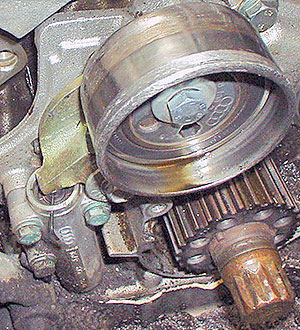
The spring loaded, hydraulically damped tensioner (lower left) pushes against the arm (gold), which acts on an offset post on the back of the tensioner pulley, rotating it to keep tension.
I think I the assembley could fit, at a different angle, in place of the 928 arm and pulley...
...
I keep coming back to a pic I took of a busted A6 engine, specifically it's tensioner assembly:
The spring loaded, hydraulically damped tensioner (lower left) pushes against the arm (gold), which acts on an offset post on the back of the tensioner pulley, rotating it to keep tension.
I think I the assembley could fit, at a different angle, in place of the 928 arm and pulley...
Thread Starter
Inventor
Rennlist Member
Rennlist Member
Joined: Sep 2002
Posts: 10,218
Likes: 468
...my birthday present, my precious...
My girlfriend bought me a copy of Project 928 today; no jacket, but first edition (are they all first edition?), thanks honey-bunny!
Anyhu, check out the manual tensioner and lack of water pump idler pulley on the ca.1974 test engine:
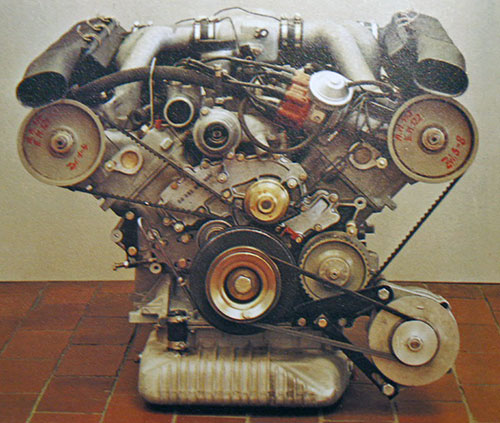
click pic for larger
I was just considering doing a similar sliding plate setup, but with the Audi tensioner.
Perhaps the idler is just to keep the belt away from the tensioner arm?
Anyhu, check out the manual tensioner and lack of water pump idler pulley on the ca.1974 test engine:

click pic for larger
I was just considering doing a similar sliding plate setup, but with the Audi tensioner.
Perhaps the idler is just to keep the belt away from the tensioner arm?