When you click on links to various merchants on this site and make a purchase, this can result in this site earning a commission. Affiliate programs and affiliations include, but are not limited to, the eBay Partner Network.
Ignition modules rarely fail, save that one for last on your list of guesses.
That’s usually what I write too: That they rarely fail.
Until last week when I did a house call and found two modules that died virtually simultaneously.
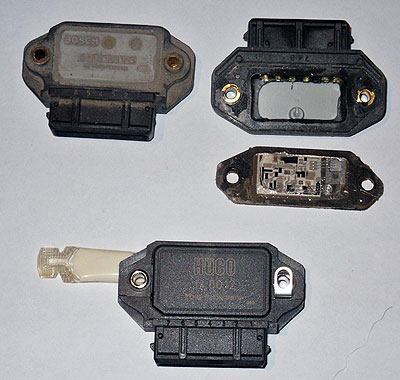
Not the original Bosch units, but *replacement* (not by me) HüCO units installed with no paste.
In any case diagnosis is so simple that *if* you are chasing a no spark issue you might as well. Just swap coils and see if the problem ‘moves’ or not.
most of this suggesting would be reduced if the OP would post pictures of the engine bay we are working on ,
as pictures can tell many stories and provide vital clues to the condition of the patient
On this 1989 car, the ignition protection relay will display a colored LED when one ignition drops out and the protection is active. On the passenger side footwell, the protection relay is visible on the ECU bracket after that carpet cover is removed. The relay displays a red or green LED to tell you which system has faulted. Protection is disabled for the first three minutes following engine start, time to let the exhaust manifolds heat up some. Look for the indicator LEDs; they are there to help you with exactly this diagnosis.
That’s usually what I write too: That they rarely fail.
Until last week when I did a house call and found two modules that died virtually simultaneously.
Not the original Bosch units, but *replacement* (not by me) HüCO units installed with no paste.
In any case diagnosis is so simple that *if* you are chasing a no spark issue you might as well. Just swap coils and see if the problem ‘moves’ or not.
This seems like a good time to bring up the maintenance item of renewing the heat transferring paste under the ignition modules. The #1 enemy of these modules is heat, the bracket they are mounted on acts as a heat sink. Just like a processor in your computer, the paste between the "chip" and the heat-sink is very important. Over time it hardens and looses its effectiveness.
Just be careful removing the modules, the paste is very sticky. These modules are pressed together and simply trying to pull one off can separate the two halves, destroying the modules. Best to "wiggle" them loose from the paste before trying to lift off.
This seems like a good time to bring up the maintenance item of renewing the heat transferring paste under the ignition modules. The #1 enemy of these modules is heat, the bracket they are mounted on acts as a heat sink. Just like a processor in your computer, the paste between the "chip" and the heat-sink is very important. Over time it hardens and looses its effectiveness.
Just be careful removing the modules, the paste is very sticky. These modules are pressed together and simply trying to pull one off can separate the two halves, destroying the modules. Best to "wiggle" them loose from the paste before trying to lift off.
That’s usually what I write too: That they rarely fail.
Until last week when I did a house call and found two modules that died virtually simultaneously.
Not the original Bosch units, but *replacement* (not by me) HüCO units installed with no paste.
In any case diagnosis is so simple that *if* you are chasing a no spark issue you might as well. Just swap coils and see if the problem ‘moves’ or not.
I've had to replace a lot of original amps as these fail more often than the coils and after installing one set of Huco's that failed shortly after, it was the last time I used 'em. Bosch or nothing. Corrosion on the wires (right side) is where I find the most issues on the spark side of things.
I've had to replace a lot of original amps as these fail more often than the coils...
I think you must see the amp and coil failures as a result of the Texas heat. Believe it or not, I have yet to diagnose a failed coil. I'm sure it will happen, but hasn't yet.
And until last week, only one failed amp module.
I do though usually , renew the CPU paste on the amps when I see a 928 for the first time.
Edit: the 928 with the dead HuCOs was originally a CA car.
Hi all and thanks for the comments on this thread. I will send a pic of the engine bay later this morning. Here's my latest problem. I mentioned earlier that I had tried swapping out the ignition relay. When that didn't do anything I thought I'd put the old relay back in and try swapping another one of the relays that were mentioned. As I was reading the manual I noticed that it said that the battery should be disconnected before replacing relays. I didn't do that for the first swap. I hope I didn't screw anything up. So I disconnected the battery and pulled the new ignition relay out and put the old one back in. Reconnected the battery. Tried to start the car but the battery seemed drained. Tried to jump it with cables attached to the battery thing in the engine bay per the manual but again no luck. There's some juice flowing as the interior lights are dimly on. Is it better to jump the car from the battery itself? Do I need to leave the cables on for a while to charge the battery? Should I get a slow charger?
Quote Dr. Bob: The '89+ cars have a protection relay that drops fuel supply to four cylinders when the exhaust temp for those cylinders indicates that there's an ignition failure on one side. This is not the "right bank" or "left bank" dropping out, but rather the four plugs fired by the right distributor or left distributor. When actvaed, the system effectively drops every other cylinder in the firing order.
To diagnose, pull the cover in the right side of the passenger's footwell. You may need to remove the whole pass footwell carpet, which is secured by a plastic tab/strap at the center of the front near the firewall, and by a couple plastic button fasteners on the floor just forward of the each seat rail. Hidden by that cover are the two 'brains' for the engine, hanging on a metal bracket. Also on that bracket near the top, facing the center of the car, is a relay that has two LED's in it. Star the engine, and look for one of the two LED's to light. Red or green. If one is lit, the EZK protection mode is active.
If the four-cylinder mode is apparent immediately from a cold start, you do in fact have an ignition problem in one distributor and will need to fix it. If the car runs fine for a minute or two, then goes to four-cylinder mode at the same time that light comes on. you may have a problem with the protection system itself. Remember, test is from a cold start, like a first-thing-in-the-morning cold start.
Likely causes of ignition fault include a coil wire that's not seated correctly (very common) or broken/melted/otherwise damaged, cap or rotor problem (easy to check), coil failure (not too common), and then on to ignition module failure, the one on the front apron on the driver's side with the little plastic cover. the pass side coil wire is the toughest to get installed correctly and therefore the most likely cause of the problem.
"Limp Home" mode is a default mode that the LH controller assumes when there's a MAF (mass air flow) sensor gross failure. It's unlikely that this is happening to you. In "limp home" mode, the LH brain assumes a fairly limited fuel supply mode based on oxygen sensor readings, so it's very soggy and has just enough power available to get you off the Autobahn at very diminished power.
You may not have reconnected the battery properly, especially the ground strap. Use a multimeter to take a voltage reading of the battery. If it reads about 12.5V or so then clean up both ends of the connectors and reconnect them tightly. If your voltage is low you can either put the battery on a charger or jump it at the battery, although many would argue against doing that.
Unless you saw smoke and sparks flying when you swapped the relay, don’t worry about it. Doubtful that you have a relay issue by what you are describing. Most everyone keeps telling you what to look at first, and it’s right there next to that relay you were messing with.
Almost all of the excellent diagnostic instructions noted above are based on having a good battery in the car. If you don't know its age (or really, even if you do), take it to a place that can put it on a good tester (such as Walmart) to verify its condition.
"Limp Home" mode is a default mode that the LH controller assumes when there's a MAF (mass air flow) sensor gross failure. It's unlikely that this is happening to you. In "limp home" mode, the LH brain assumes a fairly limited fuel supply mode based on oxygen sensor readings, so it's very soggy and has just enough power available to get you off the Autobahn at very diminished power.
There are just two Limp Home injector pulsewidths - above or below 2000 rpm (both LH 2.2 and 2.3).
Fun fact: '84-'86 ROW 16V LH2.2 brains have an (unused) output for a Check Engine Light which is triggered only by MAF failure.
Porsche 911 GT3 Artisan Edition Pays Homage to Japanese Culture
Slideshow: Porsche has created a Japan-only 911 GT3 Artisan Edition that blends track-ready hardware with design cues inspired by traditional Japanese craftsmanship.
Porsche Reveals Coupe Variant of the Electric Cayenne With a Fresh Look
Slideshow: Porsche's latest electric Cayenne Coupe blends dramatic styling with supercar acceleration, turning the brand's midsize SUV into a 1,139-horsepower flagship.