When you click on links to various merchants on this site and make a purchase, this can result in this site earning a commission. Affiliate programs and affiliations include, but are not limited to, the eBay Partner Network.
Longer answer: Yes if you allow the flame to ‘rest’ at any particular spot. Theoretically, it might be possible, but it isn’t something I’d try except as a last resort. A MAPP gas torch heats a small area very quickly to a very high temperature. It’s good for ‘shocking’ bolts and studs.
You need the whole head to be warm. Takes a lot of time. Have you an oven that can be used?
IIRC, the last time I did this (about 10 years ago) I allowed my heat gun an hour or so and used a blind-hole bearing puller.
NOTE on using the torch,
always keep the flame moving in a circular motion,
that way you will avoid localized overheating. with aluminum heat over a wider area first,
so that the whole part becomes warm then focus on the seat area
you should be able to heat the corner of the head and with a screw and slide puller remove the seat
The Mapp gas works better because it heats faster so you can get a part hotter use an IR gun heat the corner of the head to about 200F.
work the torch on the area on the outside of the head around the lower area of the seat. it should come free
OR as Dave suggested put the head in the oven and heat it to 225 F
NOTE on using the torch,
always keep the flame moving in a circular motion,
that way you will avoid localized overheating. with aluminum heat over a wider area first,
so that the whole part becomes warm then focus on the seat area
So, this head was recently rebuilt.
Will the oven method damage the new valve stem seals?
The valve stem seals are in contact with engine oil that should never be hotter than 225°F. And there’s no doubt some margin there. So, at 225°F you will be fine.
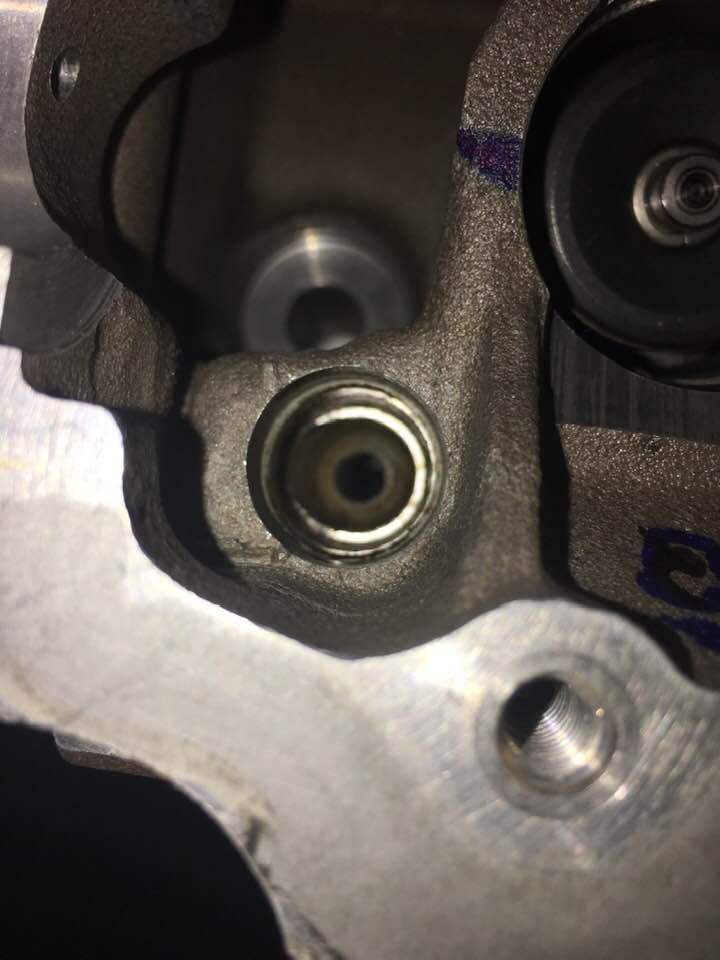
I wasn't able to get the slide hammer to latch on to anything.
Given the damage, not shocking. The puller you attach to your slide? Does it have a ‘lip’ all the way around?
No, there is no lip.
I tried earlier to get a purchase under the bottom at the drain, but no go.
I just tried the MAP gas.
Was able to get a piece of it to break off, but no release. I am thinking it is less of a Loctite issue than just pressed in.
I then put the torch on the piece by itself and it melted.
The base has been pounded so hard that it is hard to see where the seat begins. In the end it may just be a mechanical removal with various implements.
It doesn't seem like the cylindrical wall diameter is very critical, so minor blemishes (if any) from the removal process may not be a worry.
I will again have to remove the galley plugs and install new ones as I will need to re-flush the oil passages.
Heat the head as described. If you can get the whole thing to 250º that would be wonderful. You might try adding more heat in the area with a torch, knowing that aluminum conducts heat pretty well. You really want it to heat evenly to avoid warping the casting. But then the double-to-secret trick is to freeze the inserted piece with the liquid from a can of canned air computer duster. can upside down. Inserted pieces all but fall out when frozen in the heated head.
I imagine that a shot of cold air helped a bit. But it would not budge. Ultimately I went caveman. Cut some relief cuts, folded it in and it rolled on itself.
Now I have to decide if there’s a way to ensure there’s no more shavings inside. I guess I will take out the galley plugs anyway. Onward and upward. Thanks for the support






 Using Map Gas on a head