When you click on links to various merchants on this site and make a purchase, this can result in this site earning a commission. Affiliate programs and affiliations include, but are not limited to, the eBay Partner Network.
I am basing this off of the roadside speed monitors that are prevalent around here. My car overstates the speed by a minimum of 2 MPH.
Is Porsche intentionally trying to save me from myself and my heavy foot?
Anybody else notice this?
Years ago (i’m so damn old!!!) Car and Driver magazine did a speedo accuracy test on several cars that was REALLY interesting…. The worst offender was a BMW model—I’ve forgotten the actual car—but it was 7 mph optimistic! The best, most accurate vehicle tested—a Chevrolet pickup truck; it was only 2 mph or so off at 60 mph. Go figure. My wife’s Hyundai Santa Fe Sport (I know, embarrassing, but at least it’s turbocharged—stock!) per gps is only off 2 mph at 60…
There are GPS speedometer phone apps that can show actual speed. Here's the one I use on my Android phone which is on a Magsafe charger on my dash when I drive. It has many selectable sreen formats including one that's labeled something like Classic Porsche.
There is also calculus involved here. Unless you are coming around a turn and approaching the measurement device head on, you aren't actually measuring the exact speed you are going. Not exactly anyway. Draw a right angle triangle, where the hypotenuse is the line from your vehicle to the measurement device, and the other two sides are, your trajectory, and a short line from the center of your trajectory to the side of the road aligned with the measurement device. The hypotenuse is slightly longer than your actual trajectory. The measurement device is measuring the speed by looking at the change in that distance, not the change in your actual trajectory. It's a small error in most cases. The further from the road the measurement device, the larger the difference. The same goes for an officer if the law clocking you from the side of the road. The further they are from the center of your trajectory, the lower the measurement speed they will get. Again it will be small, but it also contributes to what you are talking about here.
So now you know you can prove to any police officer or judge that you were actually going FASTER than what they clocked you at.
Years ago (i’m so damn old!!!) Car and Driver magazine did a speedo accuracy test on several cars that was REALLY interesting…. The worst offender was a BMW model—I’ve forgotten the actual car—but it was 7 mph optimistic! The best, most accurate vehicle tested—a Chevrolet pickup truck; it was only 2 mph or so off at 60 mph. Go figure. My wife’s Hyundai Santa Fe Sport (I know, embarrassing, but at least it’s turbocharged—stock!) per gps is only off 2 mph at 60…
We must have had one of those BMW’s, my wife had a ’09 or ’10 328, the first year of the hardtop convertible. Those cars were the absolute worst, and her’s was far more than 7 mph over. BMW had so many complaints they had a tech note that explained the formula for speedometer error and why BMW was doing it, as long as it was within that formula range they wouldn’t do anything about it and her’s fell just inside their acceptable range. Her’s was off by something like 10 mph at 65 mph, I wish I still had a copy of that tech bulletin.
Remembering that scenario, after I picked up my (previous) X5, I tested that car using a Garmin GPS w/ WAAS (?) enabled and it was only off by 1 - 2 mph at 70 mph, I can live with that.
Last edited by Slow Guy; Apr 19, 2026 at 05:15 PM.
Whenever I get a new vehicle, I use one of the speedo GPS based apps as mentioned. Then I just drive at 60, 65.70 on cruise control on level ground and see what it tells me. Then I know the true "legal speed" I'm going for LEO's. For example if it reported 67 for. true 70, I can bump it up to 73 and then see what I get from the app. Now I know long term.
Or variant B, I'm thinking of pushing the tire width up one 10mm step (assuming it's an available size). I look at the revs per mile data from TireRack and do the math. That might be 2% for example for one step, In some Audi and VW cases, I have ended up right on top of the true speed; in others if I do it, I at least close the gap some. Not the primary reason for tweaking sizes, but can be a side benefit. Unless its a full step profile wise (or wheel goes up/down an inch without a corresponding profile change), one single 10mm width step has a modest effect on true gps speed compared to speedo reading.
The radar detector I keep in my truck has a speed indicator on the display, I have no idea how it computes the speed (suspect it’s GPS) but I’ll confirm it with my old Garmin Montana (w/ WAAS enabled) to see how accurate that is.




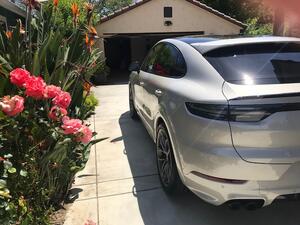

 My Speedometer Overstates the Speed