



Mystery oil leak near oil tank - how do I find it?
Instructor
Joined: Jun 2004
Posts: 117
Likes: 0
From: Norwich, UK

AFAIK those 2 mounting rubbers are the ony bits that hold the tank in, apart from the hoses; when I removed mine it took a little persuasion to come out. It would stay there without the mounting supports!!

Technical Guru
Rennlist Member
Rennlist Member
Joined: May 2002
Posts: 8,138
Likes: 122
From: USVI
Originally Posted by RSAErick
Hmmm, I wonder what might cause an overpressure? OK, I'll remove the oil line is front of the pressure release valve and try to access it from there. Just pliers, huh?
Originally Posted by RSAErick
I don't know. I'm sure that it hasn't been removed since 2002, though.
If you manage to pull the valve please post a photo.

Thread Starter
Burning Brakes
Joined: Jun 2002
Posts: 1,198
Likes: 43
From: Seattle
Originally Posted by ChrisD
AFAIK those 2 mounting rubbers are the ony bits that hold the tank in, apart from the hoses; when I removed mine it took a little persuasion to come out. It would stay there without the mounting supports!!
Thread Starter
Burning Brakes
Joined: Jun 2002
Posts: 1,198
Likes: 43
From: Seattle
Originally Posted by JasonAndreas
The exact wording in the Bentley book is, "Oil pressure relief valve is pressed into top of oil tank. To remove, pull out with pliers." I checked all the manuals I have going back to 1972 looking for a pressure relief valve and that is the only thing I could find describing the install/removal. The 993 manual warns you to plug it when testing the intake manifold for leaks but nothing else.
The original factory lines and the replacements sold today are all braided and that line is unbelievably difficult to remove with the tank in place.
If you manage to pull the valve please post a photo.
The original factory lines and the replacements sold today are all braided and that line is unbelievably difficult to remove with the tank in place.
If you manage to pull the valve please post a photo.

Burning Brakes

Joined: Jul 2004
Posts: 980
Likes: 1
From: Toronto, Canada
Originally Posted by RSAErick
... I'll be sure to post a picture of the removal and installation. ...
Technical Guru
Rennlist Member
Rennlist Member
Joined: May 2002
Posts: 8,138
Likes: 122
From: USVI
Originally Posted by DarrylH
Shop manual says - Removal: "Pull out with suitable pliers." - Installation: " ... install with Loctite 574 sealant." Good luck.
Thread Starter
Burning Brakes
Joined: Jun 2002
Posts: 1,198
Likes: 43
From: Seattle
Project Update
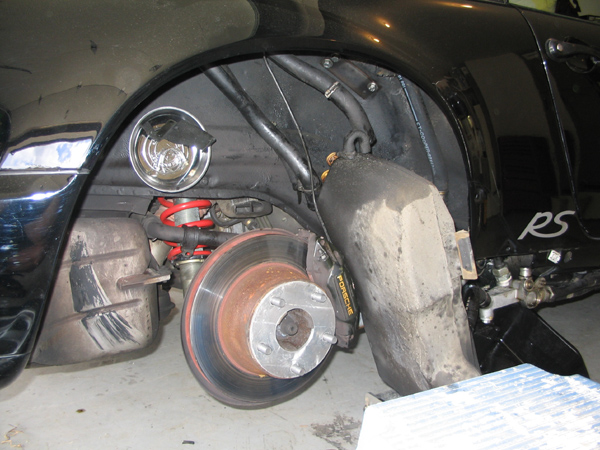
I was able to (mostly) remove the oil tank by removing all of the hoses going directly to and from the tank. It required some prying to remove the old hoses, but otherwise wasn't too difficult. Here is the result, and you can see that there is definitely some oil residue on the top of the tank. The dry side is the side that sits towards the anterior side of the wheel-well, and is only visible by removal:
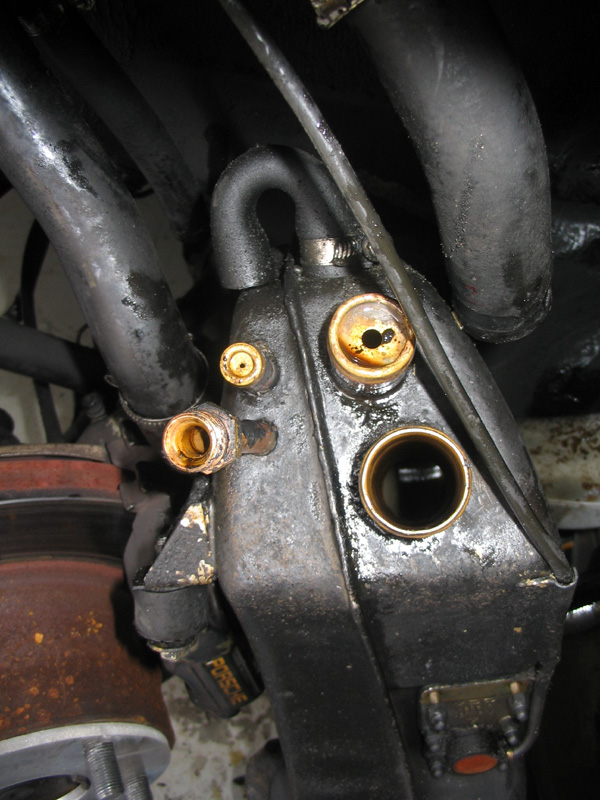
Here is a close-up shot of the oil line and dipstick connections near the top/posterior side of the tank. There is some visible oil under the hose connection nipples, but I believe that most of that came from removing oil hoses that weren't completely drained of oil. Still, I can't rule out any of these connections as possible sources of leaks yet.
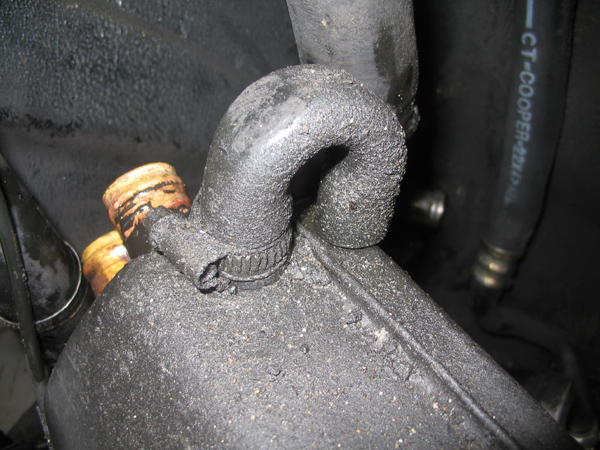
Here is a close-up shot of the breather tube on the top of the tank. Obviously it is caked with oil and debris, and looking like a source of an oil leak. Yuck:
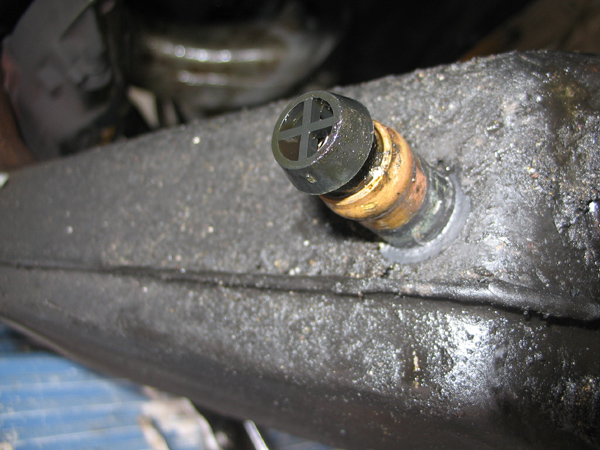
When you remove the breather tube, you find the pressure relief valve pressed into the top of the tank. It is possible to see oil on the top side of this valve, although I don't know enough about what this valve is supposed to do, to know if this is normal or not:
The pressure relief valves pulls out of the oil tank relatively easily with strong hands or pliers. There is nothing holding it into the tank other than friction. This is what it looks like:

I have ordered a new pressure relief valve and will install it using loctite 574.
That's all I have for now. I will post the results of my repairs - hopefully they fix the leak! Thanks for the guidance.
Here is a close-up shot of the oil line and dipstick connections near the top/posterior side of the tank. There is some visible oil under the hose connection nipples, but I believe that most of that came from removing oil hoses that weren't completely drained of oil. Still, I can't rule out any of these connections as possible sources of leaks yet.
Here is a close-up shot of the breather tube on the top of the tank. Obviously it is caked with oil and debris, and looking like a source of an oil leak. Yuck:
When you remove the breather tube, you find the pressure relief valve pressed into the top of the tank. It is possible to see oil on the top side of this valve, although I don't know enough about what this valve is supposed to do, to know if this is normal or not:
The pressure relief valves pulls out of the oil tank relatively easily with strong hands or pliers. There is nothing holding it into the tank other than friction. This is what it looks like:
I have ordered a new pressure relief valve and will install it using loctite 574.
That's all I have for now. I will post the results of my repairs - hopefully they fix the leak! Thanks for the guidance.
Thread Starter
Burning Brakes
Joined: Jun 2002
Posts: 1,198
Likes: 43
From: Seattle
Progress Report:
Finally received the replacement pressure relief valve and Loctite 574:
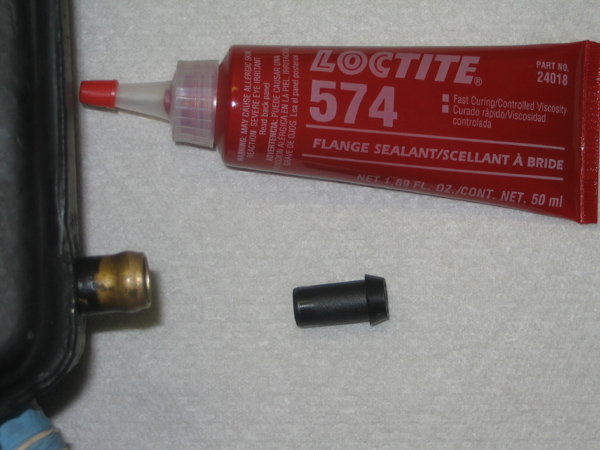
I initially loaded up the outside of the valve with Loctite, and prepared to jam it into the oil tank nipple:

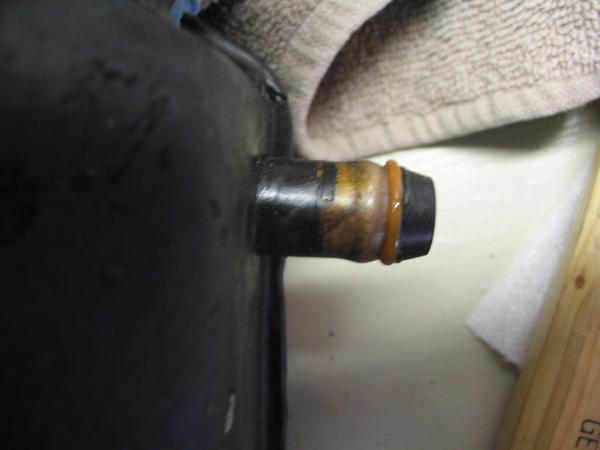
Unfortunately, the valve was so tight, I could get it in. So, I wiped off the Loctite and lightly sanded the end of the valve with 150 grit sandpaper, being careful not to get any residue in the valve. Then I tapped it into the oil tank nipple with a padded hammer. When it was almost all the way seated, I stopped and loaded up the outside with Loctite again, and tapped it all of the way in. Here you can see the residual Loctite that squeezed out when it was fully seated:
I wiped off the excess Loctite, and I'm giving it 24 hours to cure before reinstalling. I'll post results after testing.
I initially loaded up the outside of the valve with Loctite, and prepared to jam it into the oil tank nipple:
Unfortunately, the valve was so tight, I could get it in. So, I wiped off the Loctite and lightly sanded the end of the valve with 150 grit sandpaper, being careful not to get any residue in the valve. Then I tapped it into the oil tank nipple with a padded hammer. When it was almost all the way seated, I stopped and loaded up the outside with Loctite again, and tapped it all of the way in. Here you can see the residual Loctite that squeezed out when it was fully seated:
I wiped off the excess Loctite, and I'm giving it 24 hours to cure before reinstalling. I'll post results after testing.
Rennlist Stories
The Best Porsche Posts for Porsche Enthusiasts
9 Features and Characteristics That Only Porsche People Understand
Verdad Gallardo
I've Written 500 Rennlist Articles: Here's How Porsche Has Changed Along the Way
Joe Kucinski
10 Most Unnecessary Porsches Ever Built (And Why We Love Them)
Verdad Gallardo
Porsche 911 GT3 S/C vs 718 Spyder RS: 10 Categories, One Winner
Joe Kucinski
This Builder Is Turning Heads With Its Slantnose 911 Creation
Verdad Gallardo
Porsche 911 GT3 Artisan Edition Pays Homage to Japanese Culture
Verdad Gallardo
Porsche Reveals Coupe Variant of the Electric Cayenne With a Fresh Look
Verdad Gallardo
10 Porsche Colors That Have More Personality Than Most People
Verdad Gallardo
Guntherwerks' Final Speedster Creation Is the Ultimate Porsche Restomod
Verdad Gallardo
Thread Starter
Burning Brakes
Joined: Jun 2002
Posts: 1,198
Likes: 43
From: Seattle
Originally Posted by robbed666
Hi,
Watch crud going into tank, or the oil lines. As I understand it, the filter is on the return side to the tank. So debris goes around the engine/bearings first, before being filtered.
Watch crud going into tank, or the oil lines. As I understand it, the filter is on the return side to the tank. So debris goes around the engine/bearings first, before being filtered.

Burning Brakes
Joined: May 2001
Posts: 1,199
Likes: 1
From: www.cupcar.net
Here is something I'm going to throw out for consideration. When you are driving hard at the track there is more blow-by from the rings that pressurizes the tank and causes the leak past the relief valve - the valve was fine as it was. Is the engine higher mileage? Was it recently re-ringed? If so it might be experiencing this excessive blow-by. Just a thought.
Thread Starter
Burning Brakes
Joined: Jun 2002
Posts: 1,198
Likes: 43
From: Seattle
Originally Posted by JC in NY
Here is something I'm going to throw out for consideration. When you are driving hard at the track there is more blow-by from the rings that pressurizes the tank and causes the leak past the relief valve - the valve was fine as it was. Is the engine higher mileage? Was it recently re-ringed? If so it might be experiencing this excessive blow-by. Just a thought.
First, can I confirm that the purpose of he relief valve is to releases oil pressure (and subsequently, oil) when excessive pressure occurs. Then you're saying that "blow-by" past the rings is essentially compression that is going past my higher mileage (115,000 mi) rings and pressurizing the oil system. This additional oil pressure is what is causing the oil system to experience excessive oil pressure, and causing the pressure relief valve to open.
I'm relatively sure that this engine has not be "re-ringed" - otherwise the previous owner would have told me.
I can also tell you that I get blue smoke on start-ups after the car sits for an hour or so after high RPM track sessions - but I always assumed valve guides were the cause.
Finally, there is another interesting phenomenon that may be related now that I think about it. I have recently been experiencing a LOW oil pressure warning light when driving along and coming to idle. It drops past the low oil pressure warning zone before stabilizing at a 'normal' pressure - resulting in the warning light. Could this momentary low oil pressure be a signal of an open pressure relief valve OR bad rings???

Thanks for your thought provoking theory.
Burning Brakes
Joined: May 2001
Posts: 1,199
Likes: 1
From: www.cupcar.net
Hi Erick,
I'm not sure if you're understanding exactly what I'm saying. The blow-by from the rings pressurizes the crankcase but has nothing to do with the "oil pressure" that feeds the bearings. This blow-by escapes the crankcase via the breather tubes and is fed into the oil tank by hoses. With a normal healthy engine the blow-by is fairly minimal. With an engine that has tired rings or rings that never bedded in correctly (after rebuild) the blow-by gases are excessive, and cause leaks like you have. Cars that vent the breather hose to atmosphere can have oil puking from the hose that is not supposed to be coming from there. Hence the theory. THe problem would naturally get worse under track conditions where the effects of excessive blow-by are excarerbated. Did I spell that right? I don't think I ever typed that word - let alone use it in a sentance.
I'm not sure if you're understanding exactly what I'm saying. The blow-by from the rings pressurizes the crankcase but has nothing to do with the "oil pressure" that feeds the bearings. This blow-by escapes the crankcase via the breather tubes and is fed into the oil tank by hoses. With a normal healthy engine the blow-by is fairly minimal. With an engine that has tired rings or rings that never bedded in correctly (after rebuild) the blow-by gases are excessive, and cause leaks like you have. Cars that vent the breather hose to atmosphere can have oil puking from the hose that is not supposed to be coming from there. Hence the theory. THe problem would naturally get worse under track conditions where the effects of excessive blow-by are excarerbated. Did I spell that right? I don't think I ever typed that word - let alone use it in a sentance.