When you click on links to various merchants on this site and make a purchase, this can result in this site earning a commission. Affiliate programs and affiliations include, but are not limited to, the eBay Partner Network.
"...you know Marty Wyndham? He
netted $650,000 out of that
merger...26 years old, the guy's
Rambo. Got himself a Porsche Turbo
Cabriolet about 75 thou"
Yeah, but the M491 Turbo Look option was insanely expensive, causing the Carrera to be priced at V8 Ferrari levels. It was more like a 911R as far as pricing goes.
I paid $55,000 for one of my first 911's in 1985. It was a Turbo body and chassis Carrera. Not a real Turbo, just a factory Turbo body and chassis option. As Carreras went in 1985, it was a high price. The Turbo body option alone was about $11,500. That seemed like a significant amount of money in 1985, at least to me.
My current 2015 991 GTS had a MSRP of about $139,000. I got a discount, so didn't pay full MSRP. I haven't adjusted the prices for inflation, but those are representative prices 30 years apart.
Originally Posted by KenTO
That's almost $130,000 in today's dollars so close.
You're on the right track. The average U.S. inflation rate since 1985 is 2.6706 percent per year. This works out to $55,000 1985 dollars being equal to $124,483.87 2015 dollars (I did not do a partial 2016 but it looks to be around 1.1% as of August). But that's simply using an average inflation rate. If you go into the weeds and do a year by year analysis, $55,000 1985 dollars is equal to $119,986.72 2015 dollars. (The difference generally owing to different current dollar values for a specific year in relation to the inflation rate for that year.) Overall, the $139,000 you paid for a new 911 on 1/1/16 is $19,013.28 adjusted dollars more than you paid in 1985 (or 13.68 percent more).
But this information doesn't really allow you to assess the full picture about whether or not you are paying more (or less) in adjusted dollars for your car. First of all, these are general inflation averages, inflation for specific commodities vary, sometimes widely (think of inflation on a loaf or bread versus health care). So, in order to get a better picture you'd have to research inflation rates on automobiles. But this, again is only part of the picture. You are buying a German car, so in order to really see what is going on you'd have to look at inflation rates in Germany - and ideally for cars. It's good for PAG when U.S. inflation is higher than Germany, but bad if it is the other way around. Sadly, this too is not totally helpful because you'd also have to find the exchange rate DM --> $US and then Euro --> $US in order to account for any spread that may influence pricing. If you had the time to do all this research (in addition to finding the MSRP of a particular model for a particular year), then you would have a pretty good idea of the movement in the cost of a 911 over the years. It might be interesting information to know, that is, the cost of a U.S. car taking into account U.S. and German Inflation rates as well exchange rate conversions but it is a Fool's Errand though to go through all this trouble because it is just a black hole that gets less and less clearly defined. (To give you an idea, you'd have to figure out the source of the parts for a 911 and also take into account inflation and exchange rates for those as well.) Seems like this would be a good Senior Thesis project for an ECON major.
My '87 Carrera has an MSRP of $47K. It didn't have airbags, power steering or even power door locks and the AC never worked.
Even with about 200 HP, it was fun to drive then, but I wouldn't want one that didn't heat or cool the cabin adequately now, forgetting the SmartTOP I'll be ordering for my incoming Targa so I can open and close the top from outside the car.
If you thought $47K was worth what you got in '87, what I have on order at less than 3x that number seems miraculous in some ways.
The base price of a Carerra nowadays is $89k, with no options.
Seems to me that they've always been priced pretty high.
This is good, but there is a subtle, yet distinct difference between the CPI and rate of inflation. I won't be a bore and lay this out but it is easily searchable. I prefer the inflation rate over the CPI, again for reasons that are too dense. If you simply use the average rate of inflation between 1980 and 2015 (3.444 percent), $32,000 1980 dollars equals $108,127.56; if you base your calculation on sequential yearly inflation rates, $32,000 1980 dollars is equal to $103,550.81 2015 dollars.
Economist John Williams @ ShadowStats has recalculated inflation using the government formula from the 1980's and 1990's. Each administration gets better than the last at hiding real inflation. If you go back and use the gov't formula for inflation in 1990 you will see current inflation @ 5% (blue line) vs. the stated less than 2% (red line).
If you go back to the formula the gov't used in 1980 you will see current inflation at a whopping 9%.
Government is good at hiding inflation using all kinds of tricks such as substitution (steak getting too expensive? substitute it with ground beef), geometric weighting (weight things moving up in price the most the least and things moving down in price get the bigger weighting), hedonistic adjustment (modern day washing machines give you so much more joy to use so even if the price has gone up 10x we are going to call it only 5x more because the other 5x is explained by added features giving you joy), etc etc.
I will say based on casual observation of monroney labels that Porsches today cost much less than they did in the 80's.
My '87 Carrera has an MSRP of $47K. It didn't have airbags, power steering or even power door locks and the AC never worked.
Even with about 200 HP, it was fun to drive then, but I wouldn't want one that didn't heat or cool the cabin adequately now, forgetting the SmartTOP I'll be ordering for my incoming Targa so I can open and close the top from outside the car.
If you thought $47K was worth what you got in '87, what I have on order at less than 3x that number seems miraculous in some ways.
Your '87 at $47,000 would equal $100,916.26 2015 dollars. I'm not saying that you didn't get a good deal, or a bargain, or that the Targa is not worth it, just that whatever extras that the new car has should be worth what you paid minus $100,916.26. Seriously, I'm sure that they (the extras) are
As fun as this is, I have to get back to work, well, my version of work anyway.
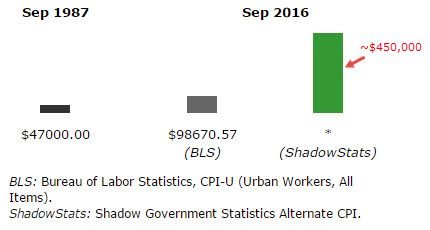
and using $47k in 1987 converted today using the BLM's absurdly low cooked inflation #'s yields $98,670. However using the real #s (this is only reserved for subscribers) but from eyeballing the height of that bar I would say it's about $450,000.
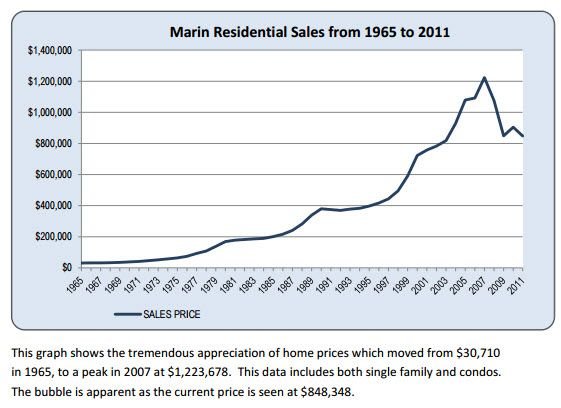
This is about right as a house in Marin County, CA in 1987 was about $200k and today is well over $1.2MM.
So the good news is that Porsches are absolute bargains today.